
The legal cannabis market has pushed past $45 billion in annual sales, and the majority of that revenue still moves through registers as physical cash. Federal banking restrictions haven't caught up with state legalization, credit card networks still won't process cannabis transactions, and most traditional banks want nothing to do with the industry.
That leaves dispensary operators managing more daily cash than almost any other retail business does, but without the financial infrastructure that every other retailer takes for granted. Miscounts bleed revenue quietly. Loose documentation turns routine state audits into disasters. And without airtight procedures, even honest teams are exposed to suspicions of theft they can't disprove.
This guide covers every stage of dispensary cash management – from the register to the bank deposit – so you can build a system that protects your money, your staff, and your license.
Why Cannabis Dispensaries Are Still Cash-Heavy in 2026
Cannabis remains federally classified as a Schedule I substance. That single fact creates the entire cash management problem.
Major credit card networks – Visa, Mastercard, American Express – prohibit cannabis transactions outright. Most federally regulated banks and credit unions refuse to open accounts for cannabis businesses due to the risk of federal money laundering charges. The SAFE Banking Act, which would protect financial institutions that serve state-legal cannabis companies, has passed the House but remains stalled in the Senate.
Alternative payment methods have made progress. PIN debit, ACH transfers, and point-of-banking systems give some dispensaries a partial path away from cash-only operations. But adoption is uneven, regulatory scrutiny of these workarounds is increasing, and cash remains the dominant payment method at most dispensaries nationwide.
The practical result: your operation handles more physical currency per square foot than almost any other retail business. Everything that follows in this guide exists because of that reality.
7 Cash Management Essentials for Cannabis Dispensaries
Managing cash in a dispensary requires care and organization. This section covers best practices for keeping your cash secure, accurate, and fully documented.
#1. Build Your Cash Handling SOPs From the Register Out
Consistent cash management starts at the point of sale, not in the back office. If your register procedures are loose, no amount of counting equipment or safe storage will fix the downstream problems.
-
Standard drawer amounts. Every register should start every shift with the same predetermined cash amount. This gives you a known baseline to reconcile against. If your POS system tracks expected cash totals per transaction, a standardized starting drawer makes end-of-shift variance calculations straightforward.
- Mid-shift drops. Set a threshold - $500, $1,000, whatever fits your volume - and require budtenders to drop excess cash into a secure lockbox or safe when the drawer hits that number. This limits the amount of cash exposed at any register during operating hours, reducing both robbery risk and the impact of any single-register discrepancy.
- Shift change counts. When one budtender hands a drawer to the next, both count it. The outgoing employee's final total and the incoming employee's opening total should match. Log both counts. If they don't match, you catch it in real time instead of discovering it six hours later during closing.
- End-of-day drawer pulls. Pull every drawer at close and count it against the POS expected total. Document the variance – even if it's zero. Consistent documentation is what separates a dispensary that sails through audits from one that scrambles.
Write all of this down. Printed SOPs that every employee signs during onboarding create accountability and give you a reference point when something goes wrong. Verbal procedures drift over time. Written ones don't.
#2. Counting: Eliminate Manual Errors With the Right Equipment
Hand-counting fails at dispensary volume. A location processing $8,000-$15,000 per day in mixed bills is asking a tired closer to accurately count hundreds of notes across five or six denominations, after a full shift. Error rates climb, counts take 30-45 minutes per drawer, and there's no way to verify the total independently.
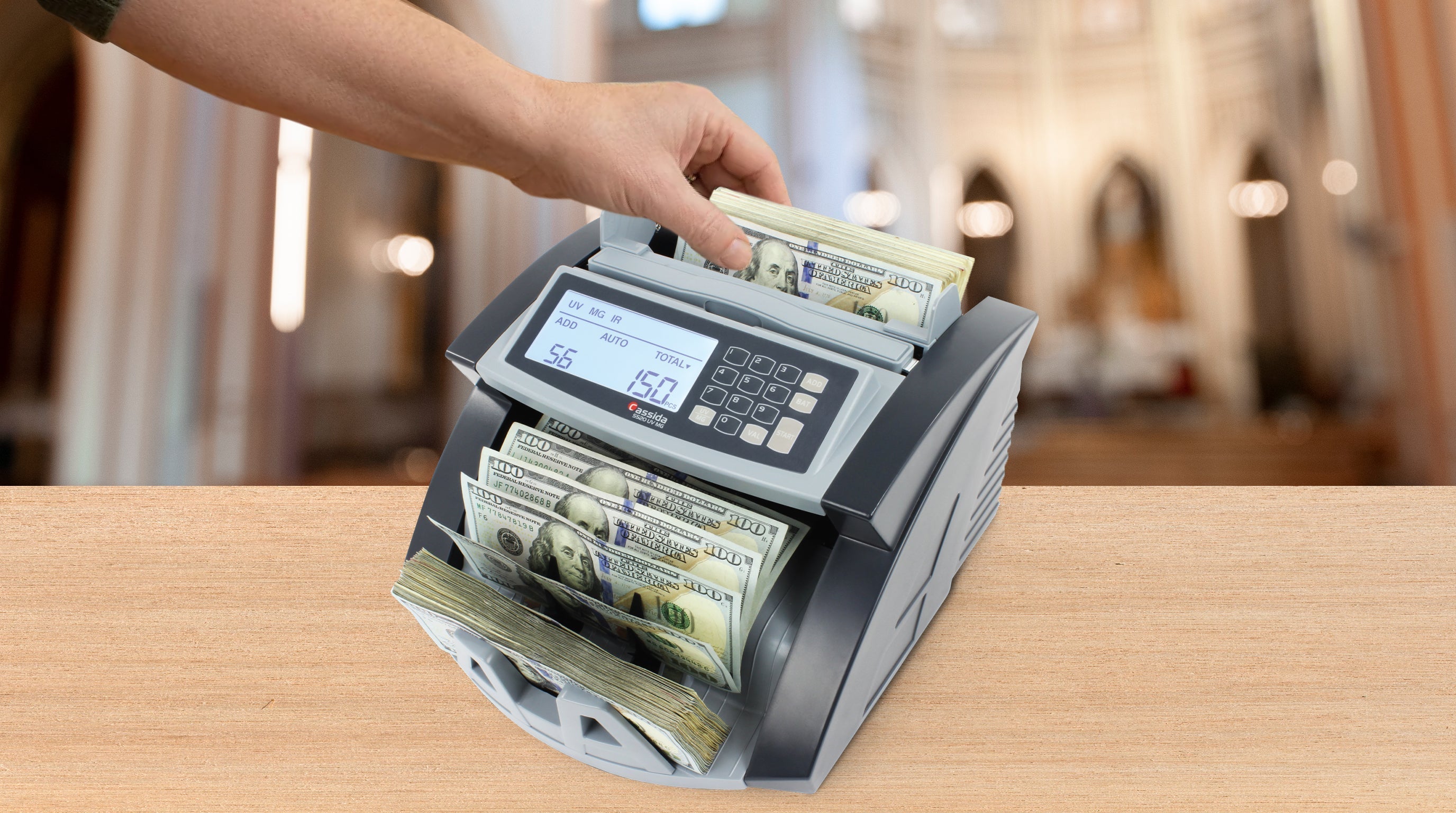
A commercial bill counter compresses that process to minutes and produces a machine-verified total every time.
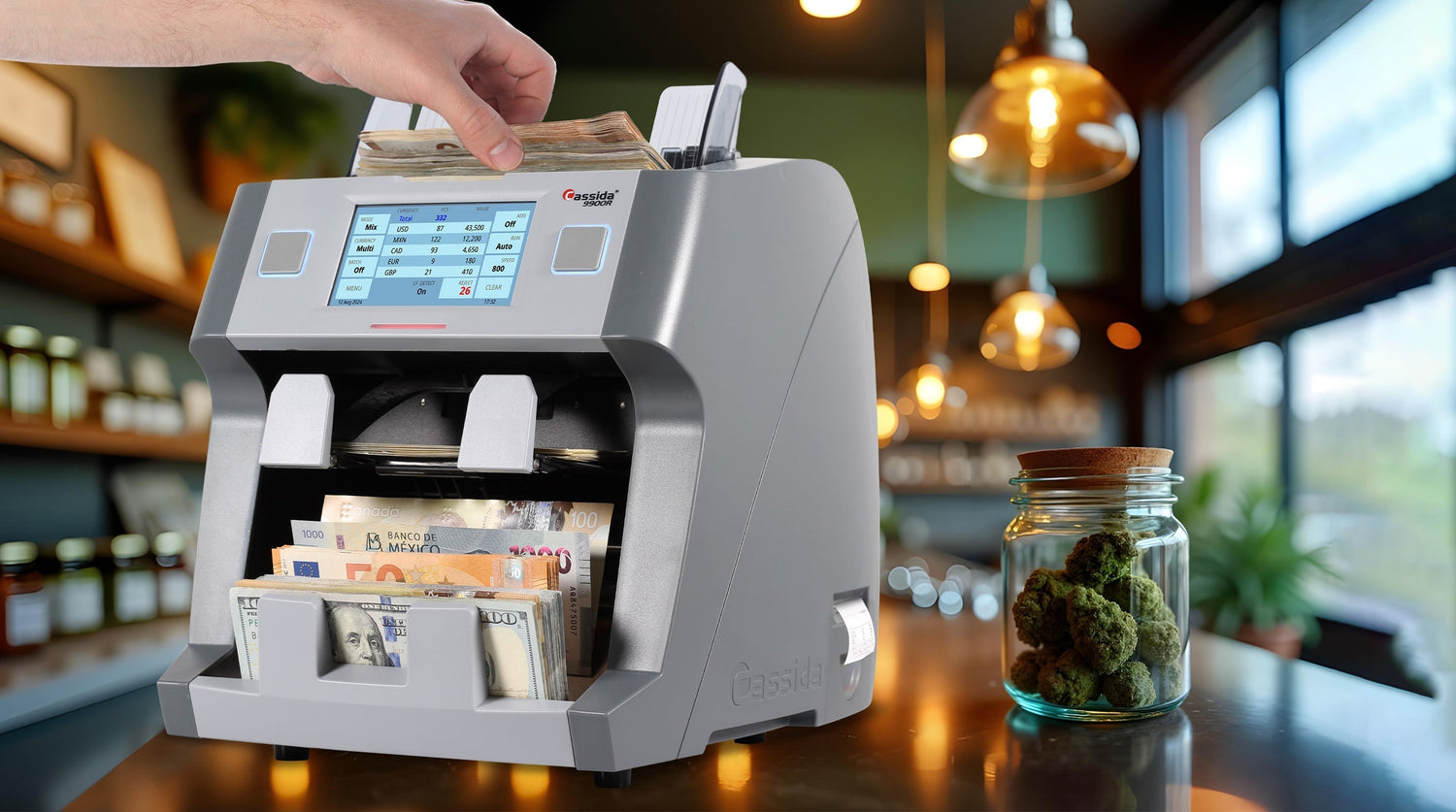
Standard vs. mixed denomination counters. If your closing procedure involves sorting bills by denomination before counting, a standard counter with ValuCount handles the job efficiently: select the denomination, load the stack, get a bill count, and a dollar total. If your team counts drawers unsorted (which is faster and more common in high-volume dispensaries), a mixed-bill counter automatically identifies every denomination in a single pass and returns a full value breakdown.

Batch mode for deposit prep. Set the counter to stop at a preset quantity (50 or 100 bills) to create deposit-ready straps without manual counting. Add mode keeps a running total across multiple stacks, so the final number on screen matches the amount on your deposit slip.
Print every count. A receipt from each counting session – showing total count, total value, and denomination breakdown – becomes the backbone of your reconciliation documentation. Attach it to the day's paperwork, and you've created a paper trail that connects your POS data to your physical cash. The Cassida Cash Handling Printer pairs with most Cassida counters for this purpose.
#3. Counterfeit Detection: Your Front Line and Back Office
Dispensaries face a heightened risk of counterfeit products for a straightforward reason: you're a high-volume, cash-only retail environment. Every bill that enters your register came from someone's pocket, ATM withdrawal, or change machine – and none of it gets screened by a bank before it reaches you.
An effective counterfeit defense operates in two layers:
Point-of-sale screening. A standalone counterfeit detector at the register lets budtenders verify high-denomination bills ($50s, $100s) in under a second. This is your first line of defense and catches the most obvious fakes before they ever enter your cash ecosystem. Counterfeit pens are unreliable, while UV and multi-sensor detectors are the standard worth investing in.

Back-office detection during counting. Bill counters with built-in multi-sensor authentication (UV, MG, IR, and CIS on advanced models) screen every bill during the counting process. This second pass catches anything that slipped past the register, including counterfeits mixed in with legitimate bills during busy periods when point-of-sale screening gets skipped. If a bill fails, the counter flags it and stops (or diverts it to a reject pocket on dual-pocket machines), so your final count only includes verified currency.
Running both layers means counterfeits get caught either at entry or during reconciliation. Neither layer alone is sufficient for the volume and risk profile of a cannabis operation.
#4. Secure Storage and Transport
Cash sitting in your dispensary is a liability until it reaches the bank. Minimizing how long it sits there – and securing it while it does – is the practical goal.
Safe requirements. At minimum, your dispensary needs a commercial-grade safe with time-delay opening (to deter smash-and-grab robbery), bolt-down mounting, and fire rating. Many state cannabis regulations specify minimum safe standards, so check your jurisdiction's requirements before purchasing. The safe should be in a restricted-access area with security camera coverage.
Deposit frequency. The more cash you hold on-site, the higher your exposure. Daily deposits are ideal for high-volume locations. At a minimum, deposit every other business day. Don't let cash accumulate over weekends if you can avoid it.
Transport. Armored transport services (like Loomis or Brinks) are the safest option and increasingly common in cannabis. They're not cheap, but for dispensaries processing $10,000+ per day, the cost is justified against the risk of an owner or manager carrying that kind of cash. If you handle transport yourself, vary your route and schedule, never go alone, and use tamper-evident deposit bags.
Camera coverage. Every area where cash is counted, stored, or transferred should be under video surveillance. This protects against external theft and, just as importantly, provides documentation that protects honest employees from false accusations. Footage retention should meet or exceed your state's cannabis regulatory requirements.
#5. Coin Management for Dispensaries With ATMs or Change Machines
Not every dispensary handles coins, but if you operate an on-site ATM, vending machine, or make change for customers, coins are part of your cash ecosystem and need the same discipline as bills.
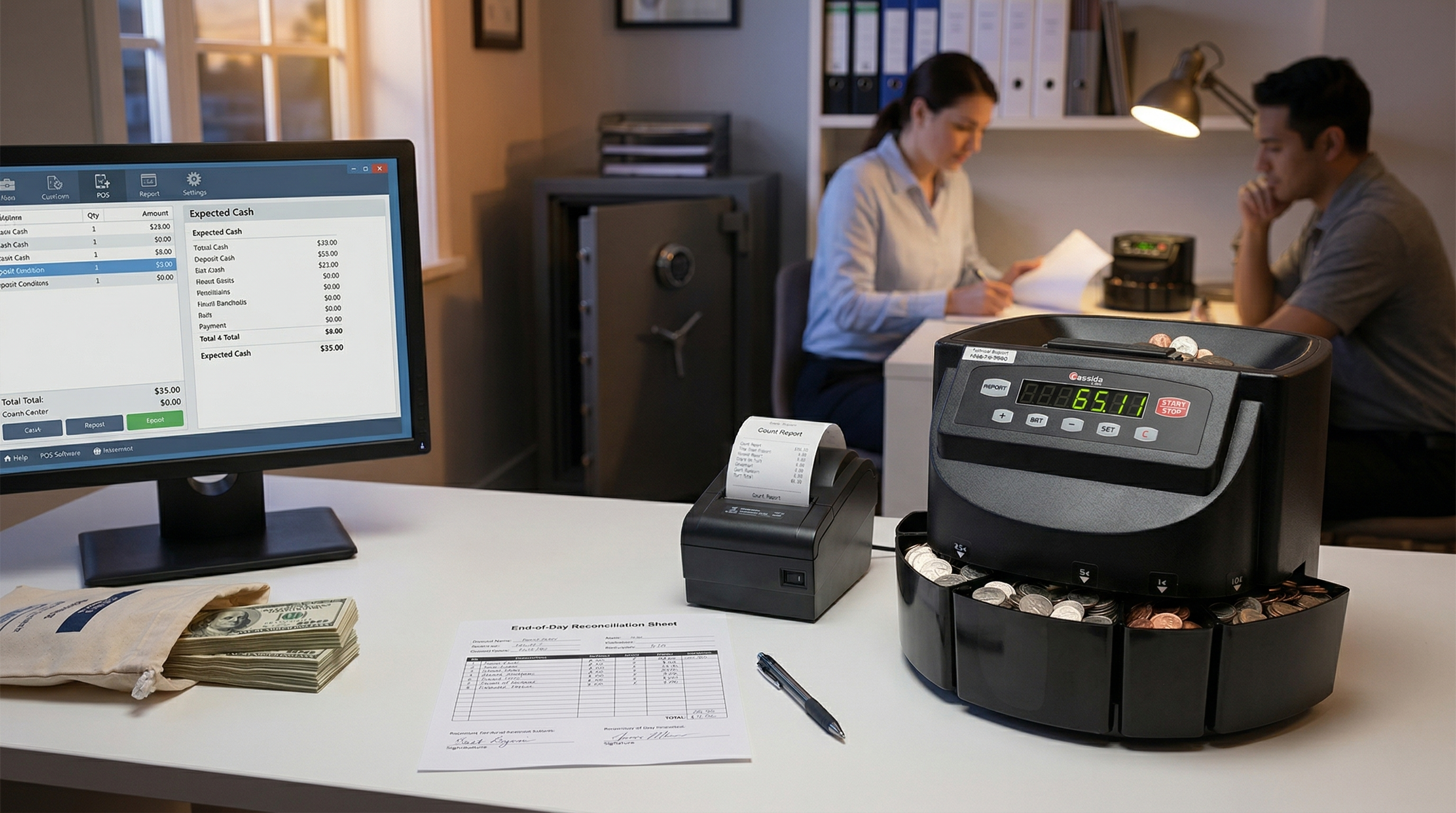
A commercial coin counter and sorter processes mixed coins by denomination, provides verified totals, and preps rolls for bank deposit. For dispensaries where coin volume is a daily factor, it eliminates another manual counting bottleneck.

Even if your coin volume is modest, count it with the same documentation rigor you apply to bills. Coins that go untracked are coins that go unaccounted for – and unexplained variances attract exactly the kind of scrutiny cannabis businesses can't afford.
#6. Record-Keeping and Compliance Documentation
Cannabis cash management isn't just an operational concern – it's a regulatory one. State licensing agencies, the IRS, and any financial institution you work with expect documentation that proves your cash totals are accurate, consistent, and traceable.
Daily reconciliation sheets. Every day, a signed document should show: the starting drawer amount, the POS expected total, the actual counted total, the variance (if any), and the names of those who counted. Attach your bill counter receipt to this sheet.
Variance logs. Track every discrepancy, no matter how small. A $5 variance on a Tuesday isn't a crisis. A pattern of $5 variances every Tuesday points to a problem you need to investigate. Logging variances over time turns your cash records from a snapshot into a trend line.
Deposit records. Match every bank deposit to a reconciliation sheet. Your deposit slip total should match your count receipt, which should match your POS expected total. That three-way match is what auditors look for.
Serial number tracking. Bill counters with serial number recognition create a bill-level record of every note you process. For dispensaries filing FinCEN Suspicious Activity Reports (SARs) or working with cannabis-friendly banks that require enhanced due diligence documentation, serial tracking provides a layer of traceability that standard counting can't.
Build an audit binder. Keep physical or digital copies of daily reconciliation sheets, count receipts, deposit slips, variance logs, and any compliance correspondence organized by month. When a state regulator or auditor asks to see your records, you hand them the binder instead of scrambling through filing cabinets.
#7. Staff Training and Accountability
The best equipment and SOPs in the world fail if the people executing them aren't trained, consistent, and accountable.
- Dual-custody counting. Two people count, always. No single employee should ever handle cash alone from the drawer to the safe. This is standard practice in banking and should be standard practice in every dispensary. It deters theft and provides a witness for every count.
- Rotate who counts. If the same manager closes and counts every night, you've created a single point of failure - and a single point of opportunity. Rotating counters across your team makes it harder for any one person to manipulate numbers and easier to spot inconsistencies when they arise.
- Cash handling agreements. Every employee who handles cash should sign a written agreement acknowledging your SOPs, the consequences for violations, and their consent to camera monitoring in cash-handling areas. This isn't about distrust, it's about clarity. When expectations are documented, there's no ambiguity.
- Frame cameras as protection, not surveillance. Your staff handles large amounts of cash in an industry that's already under a microscope. Camera coverage in counting rooms and safe areas protects employees from false accusations as much as it deters theft. Present it that way during training, and most teams appreciate the coverage rather than resenting it.
Frequently Asked Questions
#1. How much cash does a typical dispensary process per day?
It varies widely by location, market, and the availability of alternative payment methods. A single-location dispensary in a mature market might process $5,000 to $15,000 in cash per day. High-traffic locations in markets where cash remains the primary payment method can exceed $25,000 to $50,000 daily. Even dispensaries that offer PIN debit or ACH still see 50-70% of transactions settle in cash.
#2. What's the biggest cash management mistake dispensaries make?
Inconsistent documentation. Most dispensaries count their cash accurately enough – the problem is that they don't document the count in a way that withstands scrutiny. A register total without a signed reconciliation sheet, a bank deposit without a matching count receipt, a variance that nobody logged – these gaps are what turn audits from routine to painful. The cash itself is rarely the issue. The paper trail is.
#3. Do dispensaries need armored transport?
Not universally, but the calculus tips in that direction as daily volume increases. If you're transporting $10,000+ to the bank regularly, the cost of armored service (typically $200-$500/month, depending on frequency and location) is small relative to the risk of carrying that much cash yourself. Some cannabis insurance policies also offer better rates when armored transport is in place.
#4. How often should a dispensary deposit cash?
As frequently as practical. Daily deposits are ideal for locations processing $10,000+ per day. At a minimum, deposit every other business day. The longer cash sits in your safe, the higher your exposure to theft, loss, and the compliance complications that come with holding large cash reserves. Your cannabis-friendly bank may also have preferences about deposit frequency, so you should ask them.
#5. What records should a dispensary keep for a state audit?
At minimum: daily reconciliation sheets (signed by two counters), bill counter receipts for every count session, bank deposit slips matched to reconciliation sheets, variance logs documenting every discrepancy, employee cash handling agreements, and any FinCEN-related filings. Organize these by month in a dedicated audit binder. Most state cannabis regulators can request records going back 2-5 years, so establish a retention policy and stick to it.
#6. Can a bill counter replace a standalone counterfeit detector?
They serve different roles. A bill counter with built-in detection screens for every bill during back-office counting, which is great for catching counterfeits that made it into the drawer. A standalone counterfeit detector at the register catches fakes at the point of sale, before they enter your cash ecosystem. The ideal setup uses both: front-line detection at the register and multi-sensor verification during end-of-day counting.
Key Takeaways
Cannabis cash management isn't a single tool or a single procedure - it's a system that connects every touchpoint from the moment a customer pays to the moment the deposit clears.
Start with written SOPs that standardize drawer amounts, shift changes, and closing procedures. Count on commercial bill counting equipment that produces verified, printed totals. Screen for counterfeits at both the register and during back-office reconciliation. Secure cash in a compliant safe and deposit as frequently as your banking relationship allows. Document everything - daily reconciliation sheets, count receipts, deposit records, variance logs - and organize it for the audit that will eventually come.
Train your team on dual-custody counting, rotate who handles cash, and put cameras in every area where money changes hands. The goal isn't perfection on any single day - it's building a consistent system that proves your operation is tight, documented, and accountable over time.