Mosques and nonprofits collect thousands of dollars in cash donations every week using procedures that wouldn't survive basic scrutiny in any other organization – hand-counted offerings, single-person access to funds, and little to no documentation trail.
The consequences are real.
A nationwide survey found that nearly one in three mosque leaders serves in a congregation that has experienced financial misconduct.
When it happens, the damage goes beyond the balance sheet – it fractures trust in leadership, alienates donors, and can take years to rebuild.
In this article, we’ll show you how to tighten cash controls, reduce risk, and safeguard your congregation’s giving before small mistakes turn into major problems.
Why Mosques, and Charities Are Uniquely Vulnerable
Most organizations that handle significant amounts of cash - banks, retailers, casinos - operate under strict regulatory frameworks with professional staff trained in cash handling procedures. Mosques and charities operate in different environments.
They're high-trust, low-oversight organizations by nature. Cash arrives anonymously through offering plates, donation boxes, and event fundraisers. The people counting it are volunteers with minimal training and, in most cases, no background checks. Finance committees and boards are often filled with well-meaning members who lack experience in building or enforcing financial controls. And because the culture is built on trust, raising the topic of controls can feel like an accusation.
That framing is exactly backward. Cash controls don't exist because you suspect someone of stealing. They exist to protect everyone involved – the volunteers who count, the staff who deposit, and the leadership that's ultimately accountable. When a discrepancy surfaces in an organization with no controls, suspicion falls on everyone. When it surfaces in an organization with a documented system, you can trace it, resolve it, and move on.
Collection Controls: From the Plate to the Counting Room
The offering leaves the sanctuary and enters a window of vulnerability. What happens in the next few minutes determines whether your cash handling is accountable or just hopeful.
Two unrelated individuals should carry the offering from the sanctuary to the counting room. "Unrelated" matters here - spouses, parents and children, or close business partners counting together don't satisfy the dual-custody requirement in any meaningful way.
The offering should go directly to a secure counting area. No stops, no detours, no "I'll take it to my office first." Any break in the chain of custody creates a gap that's impossible to account for later. If the offering can't be counted immediately – second services, midweek events, or situations where counters aren't available – place it in a tamper-evident bag, seal it in front of a witness, and secure it until counting can begin.
Lock the door during counting. This isn't paranoia; it's procedure. An open-door counting room invites interruptions, distractions, and questions about who was present when discrepancies arise.
Camera coverage of the counting area is increasingly standard across churches and mosques of all sizes. It protects volunteers against false accusations just as much as it deters misconduct—a simple, visible camera with recorded footage costs less than a single disputed offering.
Counting Procedures That Protect Volunteers and Leadership
Every count requires at least two unrelated counters. This dual-custody principle is non-negotiable – it's the single most important control throughout the entire cash-handling process.
Rotate your counting teams. The same two people counting every Sunday for years creates both opportunity and suspicion, even when nothing is wrong. A rotation schedule of four to six teams gives you coverage without burning out volunteers.
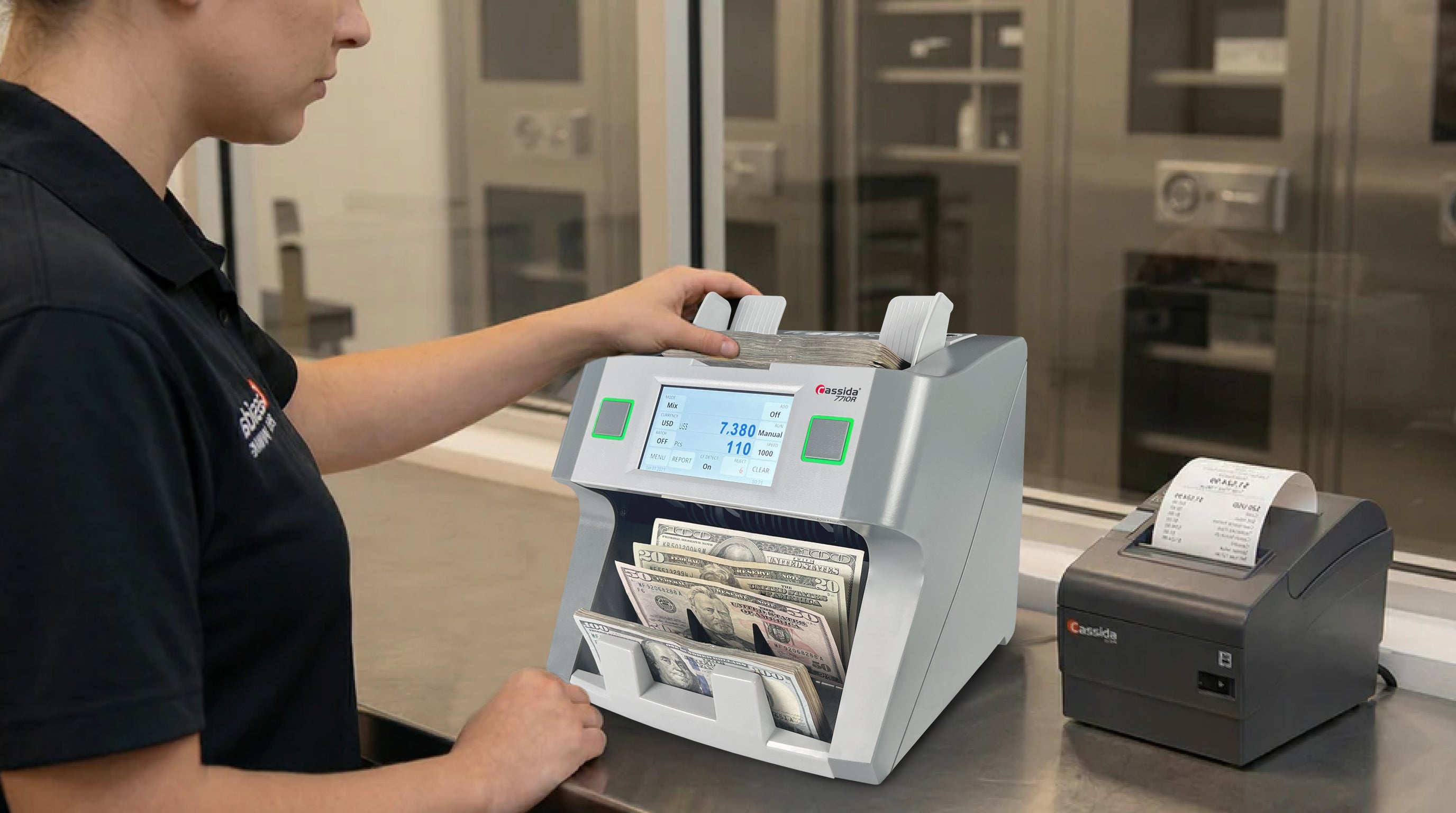
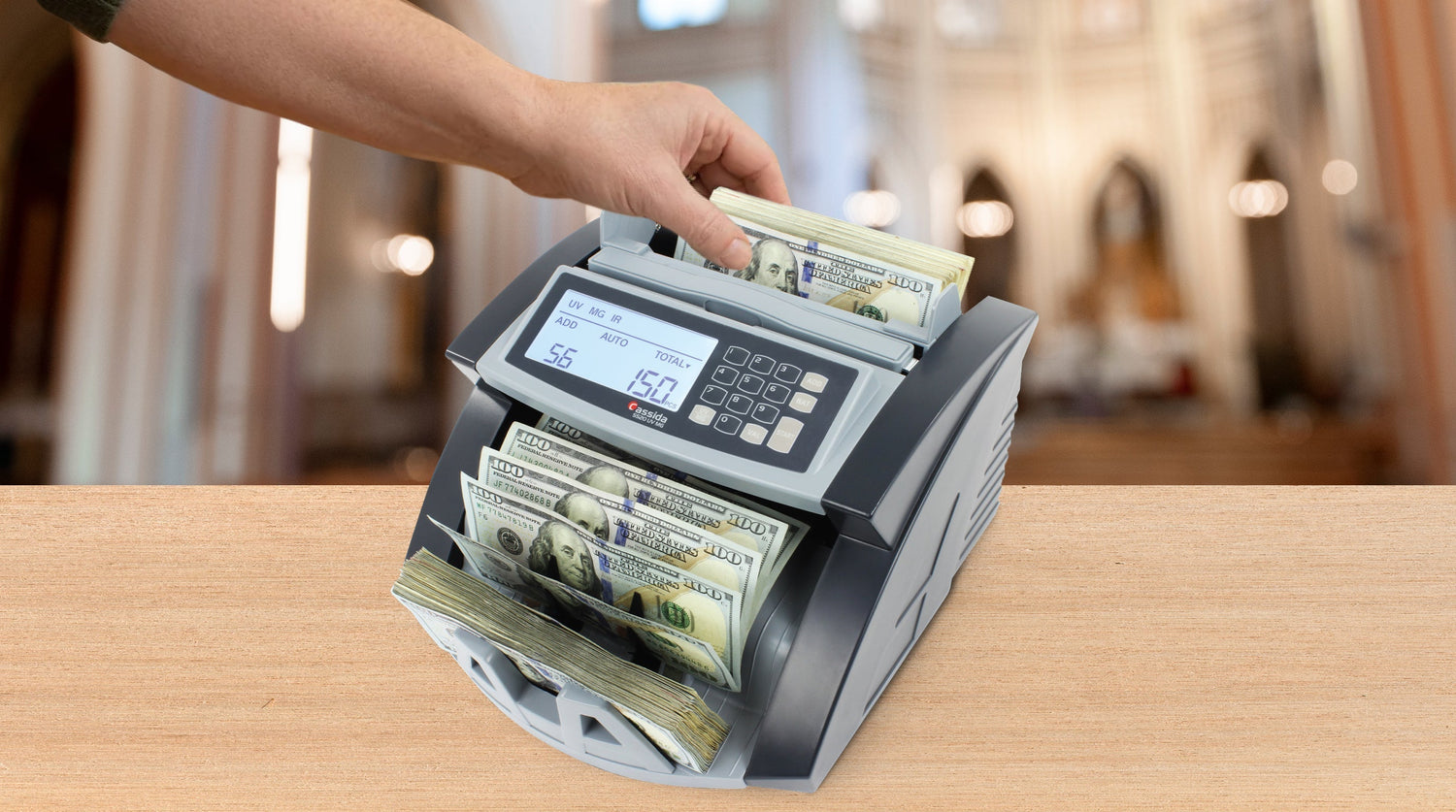
Sort bills by denomination and run them through a ValuCount bill counter for verified totals. Hand-counting cash is slow, error-prone, and impossible to verify afterward. A bill counter with built-in counterfeit-detection processes sorts stacks in seconds and produces a machine-verified total, removing human error from the equation. For churches and mosques processing mixed denominations from an offering, standard bill counters that handle one denomination at a time after sorting are the most practical and cost-effective option.
Count coins with a coin counter and sorter rather than hand-estimating. Coin totals are the most commonly fudged numbers on offering count sheets because hand-counting coins is tedious and imprecise. A coin counter eliminates the guesswork.
List checks individually – donor name and amount – for contribution records. This step serves double duty: it creates the documentation you need for donor tax receipts and gives you a line-item record that can be reconciled against bank deposits.
All counters sign the offering count sheet before anyone leaves the room. Signatures confirm that every person present agrees with the recorded totals. No exceptions, no "I'll sign it later."
Documentation: The Offering Count Sheet
The offering count sheet is the anchor document for your entire financial record. Every downstream process - your bank deposit, your general ledger entry, your donor contribution tracking, your monthly reconciliation - traces back to this single page. If it's incomplete or inaccurate, everything built on top of it will be unreliable.
Every count sheet should include the date, service or event name, bill total broken down by denomination, coin total, check total with individual listings, the total, any variance from expected amounts, and the printed names and signatures of all counters present.
Attach the printed receipt from your bill counter to every count sheet. This creates a machine-verified record that exists independently of the handwritten totals. The Cassida Cash Handling Printer connects directly to compatible bill counters and coin counters, printing time-stamped count reports that become part of your permanent documentation.
Keep original count sheets on file for a minimum of seven years. While IRS retention requirements for nonprofits vary by document type - three years for most tax-related records, four years for employment taxes - nonprofit financial advisors widely recommend seven years as a safe minimum for financial transaction records. Your state may have additional requirements, so check with a qualified accountant or attorney for guidance specific to your organization.
Counterfeit Detection in Open-Door Environments
Anyone can drop anything into an offering plate. There's no point-of-sale terminal verifying bills, no trained cashier checking for security features. Mosques typically discover counterfeits only during counting, not at the moment of donation, and only if their counting process includes detection.
Bill counters use multi-sensor detection – UV, magnetic (MG), and infrared (IR) – to catch counterfeits as bills are processed automatically. The machine flags suspect bills without slowing down the count, and your counters don't need any training in counterfeit identification.
For mosques that want a standalone detection option for event cash, large-bill donations, or situations where bills are received outside the normal offering process, dedicated counterfeit detectors provide fast, reliable verification using the same multi-sensor technology.
Counterfeiting isn't a common problem at most churches. But one undetected $100 counterfeit wipes out the cost savings of not having detection, and it's the kind of loss that's entirely preventable with equipment most mosques should already have for counting efficiency.
Bank Deposits and Reconciliation
The rule is simple: deposit the full offering. Never spend directly from the plate. Not for petty cash, not for a last-minute supply run, not for anything. The moment cash leaves the documented chain before reaching the bank, you've created an untraceable gap in your records.
The deposit slip total must exactly match the offering count sheet total. Any discrepancy – even a small one – should be documented, investigated, and resolved. Small discrepancies ignored today become patterns exploited tomorrow.
Deposit within one business day of collection. Cash sitting in a church safe over a long weekend is cash that's accumulating risk. If your bank has a night deposit option, use it. The faster cash moves from your building to the bank, the shorter the window of vulnerability.
Reconcile bank deposit confirmations against count sheets monthly. This is where you catch discrepancies between what was counted, what was deposited, and what the bank actually received. Monthly reconciliation is the financial equivalent of checking the locks – it only takes a few minutes, and the one time it catches something, it pays for itself many times over.
If your church or mosque uses fund accounting, maintain separate accounts or designated tracking for restricted funds, such as building campaigns, missions, and benevolence. Commingling designated gifts with general operating funds creates both an accounting headache and a potential legal liability.
Internal Controls for Volunteer-Run Organizations
The core principle of internal controls is the separation of duties: the person who counts shouldn't be the person who deposits, and neither should be the person who reconciles the bank statement. When one individual controls multiple stages of the cash handling process, you've created a system that relies entirely on that person's integrity, and you've eliminated any mechanism to detect a problem if integrity fails.
No single individual should have unchecked access to funds at any stage. This includes the senior pastor, the treasurer, and the longest-serving volunteer. Controls apply to everyone, or they protect no one.
The finance committee or board should review reconciliation reports monthly. This review doesn't need to be a forensic audit – it's a check to confirm that documented procedures are being followed and that the numbers make sense. Unusual patterns, unexplained variances, and missing documentation should trigger questions, not accusations.
Conduct an annual independent review or audit. A full independent audit by a CPA firm is the gold standard. Still, even an informal review by a qualified member who isn't involved in day-to-day financial operations is better than nothing. The point is fresh eyes on the numbers at least once a year.
Written financial policies adopted by the board create accountability and set expectations. When controls are documented and formally approved, they become organizational standards rather than suggestions. New volunteers and staff know what's expected from day one, and leadership has a framework for addressing deviations.
Special Situations: Events, Fundraisers, and Designated Giving
Fundraiser cash follows the same rules as Sunday offering cash. Whether it's a gala, a bake sale, a car wash, or a 5K registration table, the principles remain the same: dual custody, immediate documentation, secure handling, and timely deposit. The informal atmosphere of a fundraising event is exactly where controls are most likely to slip - and most needed.
Designated gifts - building fund contributions, missions support, benevolence offerings - must be tracked separately from general giving. Donors who designate a gift for a specific purpose have a reasonable expectation that it will be used for that purpose. Failing to track designated funds accurately isn't just sloppy bookkeeping; in many states, it's a legal violation.
Online and mobile giving have grown, but they haven't eliminated cash. Most mosques still receive 30-50% of total donations in cash and checks. Digital donations supplement cash – they don't replace it, and they don't reduce the need for physical cash controls.
Plan for volume spikes. Holiday services, special campaigns, Ramadan, and annual fundraising events can push offering volumes to two or three times normal levels. Make sure you have enough counting capacity and trained volunteers scheduled for peak days. Running a $15,000 Easter offering through a process designed for $5,000 Sundays is how errors and shortcuts happen.
Frequently Asked Questions
#1. How many people should count the offering?
A minimum of two unrelated individuals for every count, no exceptions. "Unrelated" means no spouses, family members, or close business partners counting together. Larger churches with higher offering volumes may need three or four counters to process efficiently, but two is the minimum for accountability.
#2. Should mosques use a bill counter for offerings?
Yes. A bill counter eliminates hand-counting errors, produces a machine-verified total, and, when equipped with UV/MG/IR sensors, automatically screens for counterfeits. It also significantly reduces counting time, which means less time your volunteers spend behind a locked door and faster deposits to the bank. For most mosques, a standard single-denomination bill counter with ValuCount and counterfeit detection is the right fit.
#3. How long should a church keep financial records?
The IRS requires nonprofits to retain records supporting their tax returns for at least three years from the filing date, with certain records requiring longer retention. Nonprofit financial advisors widely recommend keeping financial transaction records, including offering count sheets, deposit slips, and bank statements, for at least 7 years. Governing documents, such as articles of incorporation, bylaws, and board minutes, should be kept permanently. Consult a CPA or attorney for guidance specific to your state and organizational structure.
#4. What happens when a church discovers financial misconduct?
Secure all financial records immediately – paper and electronic. Contact the church's attorney and insurance carrier. Consider hiring a CPA or Certified Fraud Examiner to assess the scope. A survey found that among mosques that experienced fraud, only about a third filed a report with law enforcement, but experts strongly recommend reporting as an act of stewardship toward the broader church community. Handling misconduct internally and allowing the offender to leave quietly exposes other organizations to the same risk.
#5. Do small churches need formal cash controls?
Small mosques need controls more, not less. They typically have fewer volunteers, which means less natural separation of duties and more opportunity for a single individual to control multiple stages of cash handling. The controls don't need to be elaborate - two-person counting, signed count sheets, timely deposits, and monthly reconciliation cover the fundamentals regardless of church size.
#6. How should mosques handle designated donations?
Track designated gifts separately from the general offering, either through separate bank accounts or a fund accounting system that maintains distinct records within a single account. Document the designation at the point of counting – a note on the envelope, a line on the check memo, or a notation on the count sheet. Report designated fund balances to the board regularly, and ensure restricted funds are spent only for their intended purpose.
Key Takeaways
Cash income controls aren't about distrust - they're about protecting your volunteers, your leadership, and the donors who give generously. The framework is simple: dual custody from the plate to the counting room, machine-verified counts with bill counters and coin counters, complete documentation on every count sheet, timely deposits, monthly reconciliation, and separation of duties at every stage. None of this requires a professional accounting staff or an expensive overhaul. It requires written policies, consistent execution, and leadership willing to treat financial accountability as a core responsibility - because it is.