
Self-service and coin-and-token laundries are a growing part of Dubai's residential neighbourhoods, and owners running these machines lose hours every week hand-counting AED coins and tokens from the vaults - a tedious process that invites miscounts, slows down deposits, and makes it nearly impossible to spot revenue discrepancies before they become real problems.
When you can't trust your coin totals, you can't trust your financials. Shrinkage goes undetected, and reconciling revenue against your machine cycle logs becomes a guessing game.
An automated coin counter, paired with the right collection routine, turns a multi-hour chore into a 15-minute process - with totals you can actually bank on.
In this guide, we'll walk through seven coin and token counting tips that turn a messy manual process into a fast, auditable routine, using cassida.me's AED-calibrated coin counters.
#1. Invest in a Commercial-Grade Coin Counter
The single biggest upgrade a laundry owner can make to their coin-handling process is switching from manual counting to a commercial coin counter and sorter designed for daily use.
Entry-level counters jam constantly, miscount when hoppers are full, and break down within months under the volume a busy self-service laundry generates. A location running a dozen or more washers and dryers can pull in a substantial number of AED 1 coins per week, plus any tokens used in place of loose coins.
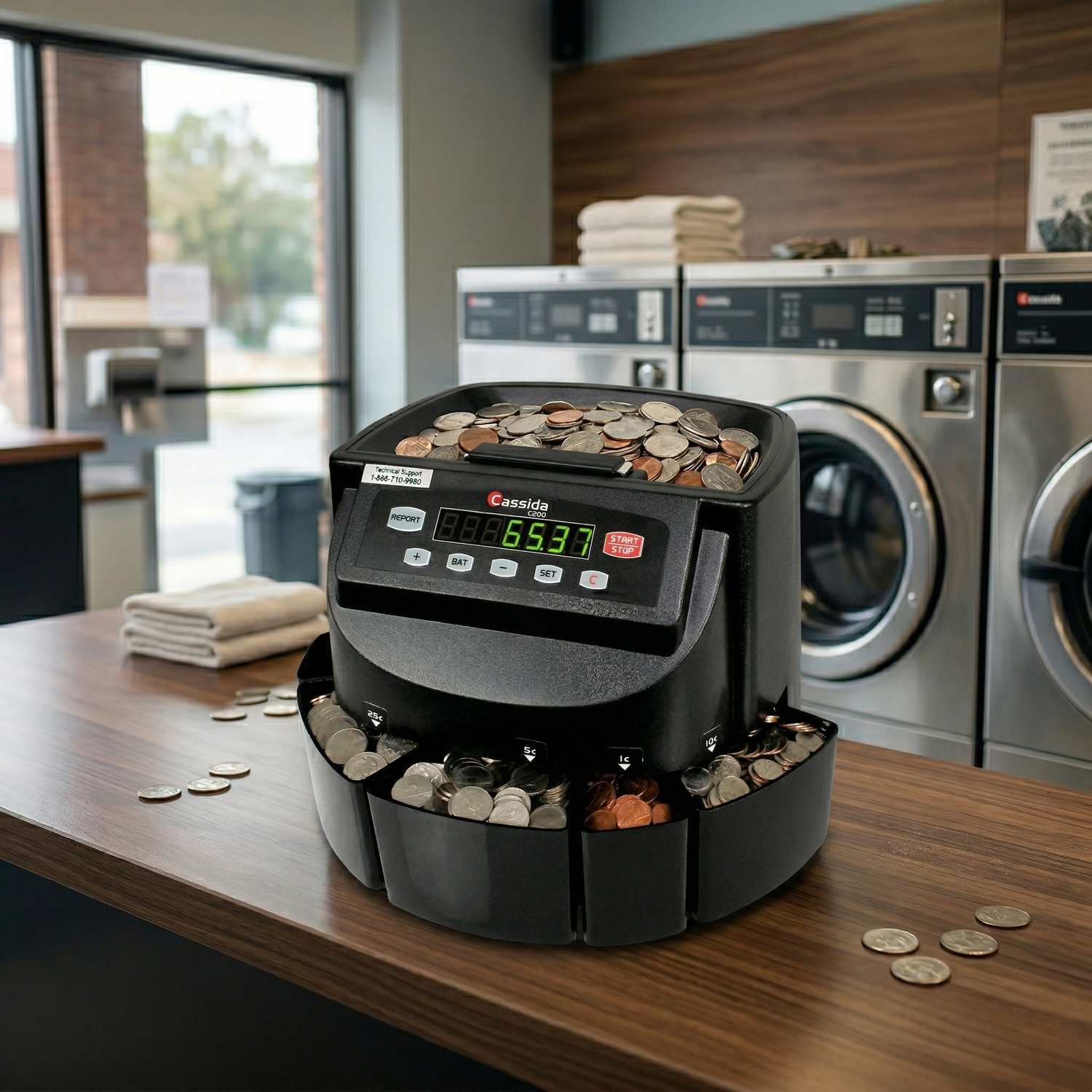
Commercial-grade machines like the Cassida Coinmaster are purpose-built for this kind of volume. It's calibrated specifically for AED coin denominations, counts and sorts at up to 350 coins per minute, and holds up to 2,500 coins in the hopper — enough to process a typical single-location collection without constant reloading.

For a higher-volume location or an owner running several laundry sites, the Cassida Coinmax steps up to heavier-duty processing with a larger throughput and a sturdier build for daily commercial use.

If your machines run on tokens rather than (or alongside) AED coins, the Cassida C550 is worth a look. It's a universal manual coin counter with adjustable diameter and thickness dials, so it can count tokens or foreign coins alongside standard AED denominations - a genuinely useful feature for a Dubai laundry that mixes coin and token payment.
The right machine pays for itself within weeks, just from the time it saves. More importantly, it gives you a verifiable count for every single collection - something that matters for everything from bank deposits to theft prevention.
#2. Set a Consistent Collection Schedule and Stick to It
One of the most common mistakes laundromat owners make is collecting coins on a random or "whenever I get around to it" schedule. Inconsistent collection creates three problems at once.
Overfull coin vaults can jam machines, taking them out of service and costing you revenue during peak hours — typically weekday evenings and weekends in most residential Dubai communities. Irregular schedules also make it impossible to track weekly revenue trends: if you collect every five days one week and every nine the next, your numbers are useless for comparison. And a predictable-but-not-public schedule helps with security - varying your exact collection time while keeping to regular intervals prevents patterns that could make you a target.
For most single-location laundries, collecting twice a week works well. High-traffic locations near larger residential blocks may need more frequent collection. Whatever frequency you choose, log every collection with the date, time, and total amount counted. Your coin counter's Add mode makes running totals easy.
#3. Count at the Location, Not at Home
It's tempting to bag up coins at the laundromat and bring them home to count later. Don't.
Counting on-site immediately after collection creates a closed loop – you pull the coins from the machines, count them on the spot, and record the total before anything leaves the building. If someone else handles coin collection for you, this is especially critical. There's no window for coins to "go missing" between the vault and the counter.
Set up a small counting station in your back office, storeroom, or utility cupboard. A compact counter like the Coinmaster has a built-in handle and fits easily on a desk or shelf. Pair it with a lockable coin bag and a simple log — paper or a spreadsheet on your phone — and you have a complete on-site counting station that takes up almost no space.
#4. Use Batch Mode to Prep Bank Deposits Faster
Most laundry owners count their coins, bag them, and head to the bank. But dumping loose coins into a bag makes extra work at the teller counter, and some banks in the UAE prefer or require rolled or bagged coin in standard quantities for large deposits.
Every Cassida coin counter includes a Batch mode that lets you set a specific coin count per run. Set it to your bank's preferred roll or bag quantity, and the machine stops automatically once it hits that number - giving you a deposit-ready batch without counting a single coin by hand.
Batching your coins before deposit has practical benefits beyond bank convenience: it's easier to transport securely, it's pre-verified by your machine's count, and it gives your bank no reason to recount or question your totals.
#5. Track Revenue Per Machine, Not Just Totals
Counting your total weekly coin haul tells you how much your laundry made. It doesn't tell you which machines are performing and which ones are costing you money.
If you collect from each machine (or at least each machine type — top loaders, dryers) into separate containers before running them through your counter, you can track revenue at a much more granular level. This data reveals patterns an aggregated total hides. A washer that's consistently pulling in noticeably less than identical machines next to it probably has a mechanical issue customers have noticed but haven't reported. Revenue-per-machine tracking turns your coin count from a bookkeeping task into an operational intelligence tool.
#6. Clean Your Coin Counter Weekly - Laundry Coins Are Dirty
This is the tip most owners skip until their machine starts miscounting or jamming.
Coins from laundry machines are among the dirtiest in commercial cash handling. They've sat in pockets, run through wash cycles, and picked up lint and detergent residue in Dubai's humid climate. All of that debris accumulates inside your coin counter's sensors and pathways, gradually degrading accuracy and causing jams.
A weekly cleaning session - wiping down sensors and clearing lint from the hopper - prevents most counting errors before they start. For the Coinmax and C550, pay special attention to the coin thickness adjustment mechanism, since bent or debris-coated coins are common in laundry collections.
#7. Filter Out Bad Coins Before They Recirculate
If your laundry uses a change machine or accepts tokens issued from a dispenser, you're likely recirculating coins from your vaults back into circulation. That's efficient, but only if you're filtering out damaged, bent, or foreign coins first.
Bad coins are a leading cause of jams in washers and dryers. A bent AED 1 coin that slips through collection and back into a change machine will eventually jam a customer's washer, taking that machine offline until you can clear it - and every out-of-service machine costs you revenue.
The Cassida C550's adjustable diameter and thickness dials give you fine control over what gets accepted during counting, letting you reject anything borderline before it goes back into your machines. This one step can meaningfully reduce machine downtime and service calls.
Frequently Asked Questions
#1. Do self-service laundries in Dubai really need a coin counter?
Any location collecting a meaningful volume of coins per week will save real time with a commercial counter. A machine like the Coinmaster processes a typical collection in well under 30 minutes with a verified total, compared to an hour or more counting by hand - and the improvement in accuracy pays off at reconciliation time.
#2. What's the best coin counter for a small, single-location laundry?
The Cassida Coinmaster is the sweet spot for a small to mid-size location. It's calibrated for AED coins, counts and sorts at up to 350 coins per minute, and its Count, Batch, and Add modes make collection management straightforward.
#3. What's the best option for a larger or multi-location laundry?
The Cassida Coinmax is designed for higher-volume operations, with faster throughput and a sturdier build for daily commercial use across multiple sites.
#4. Can I use a coin counter with tokens?
Yes. The Cassida C550 features adjustable diameter and thickness dials, allowing it to count tokens and foreign coins alongside standard AED denominations — useful if your laundry machines run on a token system.
#5. How often should I clean my coin counter?
Weekly, at a minimum. Laundry coins carry more debris than typical commercial coins because they're exposed to detergent residue, lint, and Dubai's humidity. A quick cleaning takes about five minutes and keeps your machine running accurately.
#6. Should I bag or roll coins before depositing?
It depends on your bank's policy — some UAE banks accept bulk coin with a verified count slip, while others prefer standard bagged quantities. Every Cassida coin counter includes a Batch mode that stops at a preset quantity, making either approach straightforward.
Key Takeaways
A coin counter is one of the fastest-returning investments a laundry owner can make - saving hours per week, producing verifiable totals for every collection, and catching bad coins before they jam your machines. For smaller operations, the Cassida Coinmaster delivers reliable AED-calibrated counting and sorting at an accessible price. Higher-volume and multi-location operators should look at the Cassida Coinmax, and any laundry running a mixed coin-and-token system should consider the Cassida C550 for its adjustable, universal counting capability.
Pair any counter with a consistent collection schedule, on-site counting, per-machine revenue tracking, and weekly cleaning, and you'll turn the most tedious part of running a self-service laundry into one of the most dialed-in systems in your business.