

Most cash-heavy businesses in Dubai know that manual counting is slow. But slow is only part of the cost they can see. The real damage sits in the costs they can't — or haven't bothered to calculate.
Miscounts that go undetected for weeks. Counterfeit notes that walk straight through a visual check. Overtime that accrues every closing shift. Theft that hides behind the absence of a verifiable paper trail. These aren't edge cases. They're the everyday math of hand-counting cash, and they compound quietly until somebody finally does the numbers.
Once you see what manual cash management actually costs a business per year, the case for a commercial bill counter becomes hard to ignore.
This article breaks down these hidden costs and shows how the right cash-handling tools and procedures can save time, prevent losses, and make every dirham verifiable.
#1. Labor Hours You're Paying for but Not Tracking
Manual cash counting is pure single-task labour. Your closer isn't serving customers, restocking, or doing anything productive while hunched over a stack of notes. They're counting. And then recounting, because the first total didn't match.
The math is straightforward. A typical manual count takes 20–30 minutes per session. If your business counts once a day, at a fully loaded staff cost of roughly AED 20–30 per hour, that's a meaningful sum spent on counting alone every year — and if you count twice daily (opening and closing, or multiple registers), that figure climbs further, just for the labour of moving notes from one stack to another.
A commercial bill counter compresses a 30-minute count to 3–5 minutes. That's an 80–85% reduction in counting labour — time your closers get back for productive work, or time that shaves 25 minutes off every closing shift.
#2. Counting Errors That Silently Drain Revenue
Humans are bad at counting large volumes of identical-looking objects. It's not a character flaw — it's a cognitive limitation. Attention drifts. Notes stick together. Denominations get mixed. An AED 50 lands in the AED 100 stack, and nobody notices.
Industry estimates place the manual cash-counting error rate at 1–3% per session. On AED 15,000 in daily cash, a 1% error rate results in around AED 150 per day in unresolved discrepancies. Over a year, that adds up to tens of thousands of dirhams that either went missing, got misattributed, or were simply never accounted for correctly.
The bigger problem is that most manual errors go undetected. When the count is the only count, there's no verification step. The number written down becomes the truth, whether it's accurate or not. Discrepancies between the till total and the counted total get shrugged off as "close enough."
Machine counting delivers 99.9%+ accuracy with a repeatable, verifiable total. If two counts disagree, run it again in 90 seconds to see which one was right.
#3. Counterfeit Notes That Walk Right Past Manual Inspection
Your cashiers and managers aren't trained counterfeit examiners. They're not supposed to be. But manual cash management puts them in that role by default — and the tools most businesses give them (a quick visual check, at best) aren't up to the task.
Modern counterfeits are produced with equipment that can replicate UV-reactive ink and security features well enough to fool the naked eye. A single undetected AED 500 or AED 1,000 counterfeit note is a direct, unrecoverable loss to your business.
Standalone counterfeit detectors at the point of sale catch fakes before they enter your cash flow. Bill counters with built-in multi-sensor authentication (UV, MG, IR — and CIS image scanning on Cassida's mixed-value models) add a second layer of screening during back-office counting. Running both layers means counterfeits get flagged either at entry or during reconciliation, without adding any manual inspection steps for your team.
#4. Employee Theft That Hides in Manual Processes
This isn't an accusation. It's a structural reality of manual cash handling.
When one person counts cash alone, writes the total on a notepad, and drops the deposit in a bag, there is no independent verification of that number. Nothing proves the count was accurate. Nothing proves the notes weren't removed between the till and the count. Nothing protects an honest employee from suspicion if the deposit comes up short at the bank.
The numbers on this are sobering. According to the Association of Certified Fraud Examiners' global research, businesses lose a meaningful share of annual revenue to employee fraud and abuse, and cash-handling roles remain a common point of exposure - particularly for smaller businesses that rely on manual, single-person counting.
Machine-verified counts eliminate the ambiguity. A logged or printed count from a commercial counter records the exact total, the denomination breakdown, and the time of the count. Pair that with dual-custody counting procedures (two people present for every count), and you've closed the gap that manual processes leave wide open. This setup protects honest employees just as much as it deters dishonest ones.
#5. Overtime and Turnover from Tedious Closing Procedures
Nobody took a retail or hospitality job because they love counting cash at midnight. But that's exactly what manual counting demands of closing staff - 30 to 45 minutes of tedious, error-prone work at the end of every shift, when accuracy is at its lowest and the desire to leave is at its highest.
When counts don't balance on the first pass, recounts add another 10-15 minutes. Multiply that across a busy week, and overtime accrues fast, particularly for hourly staff already near their scheduled hours.
The turnover angle is harder to quantify, but it's real. Closers who consistently stay 30-45 minutes past their shift for a task they dislike burn out and leave faster. Every departure triggers recruitment and training costs - a real consideration given the UAE's tight hospitality and retail labour market - and a learning curve during which the new employee's counts are even less reliable than the person they replaced.
A bill counter that processes a full drawer in under five minutes doesn't just save time on count night; it makes the closing shift shorter, less frustrating, and more likely to retain the people running it.
#6. Compliance Gaps with No Paper Trail
A manual count produces a handwritten number. That's the entire record - no denomination breakdown, no printed receipt, no serial tracking, no timestamp beyond whatever your closer jots in a logbook.
For businesses in regulated or high-scrutiny sectors - exchange houses, jewellery and gold trading, and hospitality operators handling significant daily cash - this is a documentation liability. Banking partners and, where applicable, the UAE's Financial Intelligence Unit expect documentation that connects your recorded totals to physical cash counts to bank deposits. A handwritten number on a notepad doesn't meet that standard.
Even outside heavily regulated sectors, weak documentation creates problems. If a bank questions a deposit amount, you have no verified record to reference. If an employee disputes a shortage allegation, there's no independent evidence to resolve the dispute. If the Federal Tax Authority reviews your cash-handling records as part of a VAT audit, a stack of notebooks with ballpoint totals proves very little.
Bill counters with printer or logging capability generate a record for every count session. Attach that record to a signed reconciliation sheet, match it to your deposit slip, and you've built a three-way paper trail that holds up under scrutiny.
#7. Deposit Prep Time Nobody Accounts for
Counting is only half the job. Once the notes are counted, someone still has to sort them by denomination, strap them into deposit-ready bundles, bag or batch coins, and reconcile everything against the till record. For businesses that hand-count cash, deposit prep adds 15–20 minutes to the count itself.
Mixed-value counters eliminate the sorting step - dump an unsorted stack of mixed denominations (and, on multi-currency models, mixed AED and foreign notes) into the hopper, and the machine identifies, counts, and organises everything in a single pass. Batch mode stops at preset strapping quantities without manual counting.
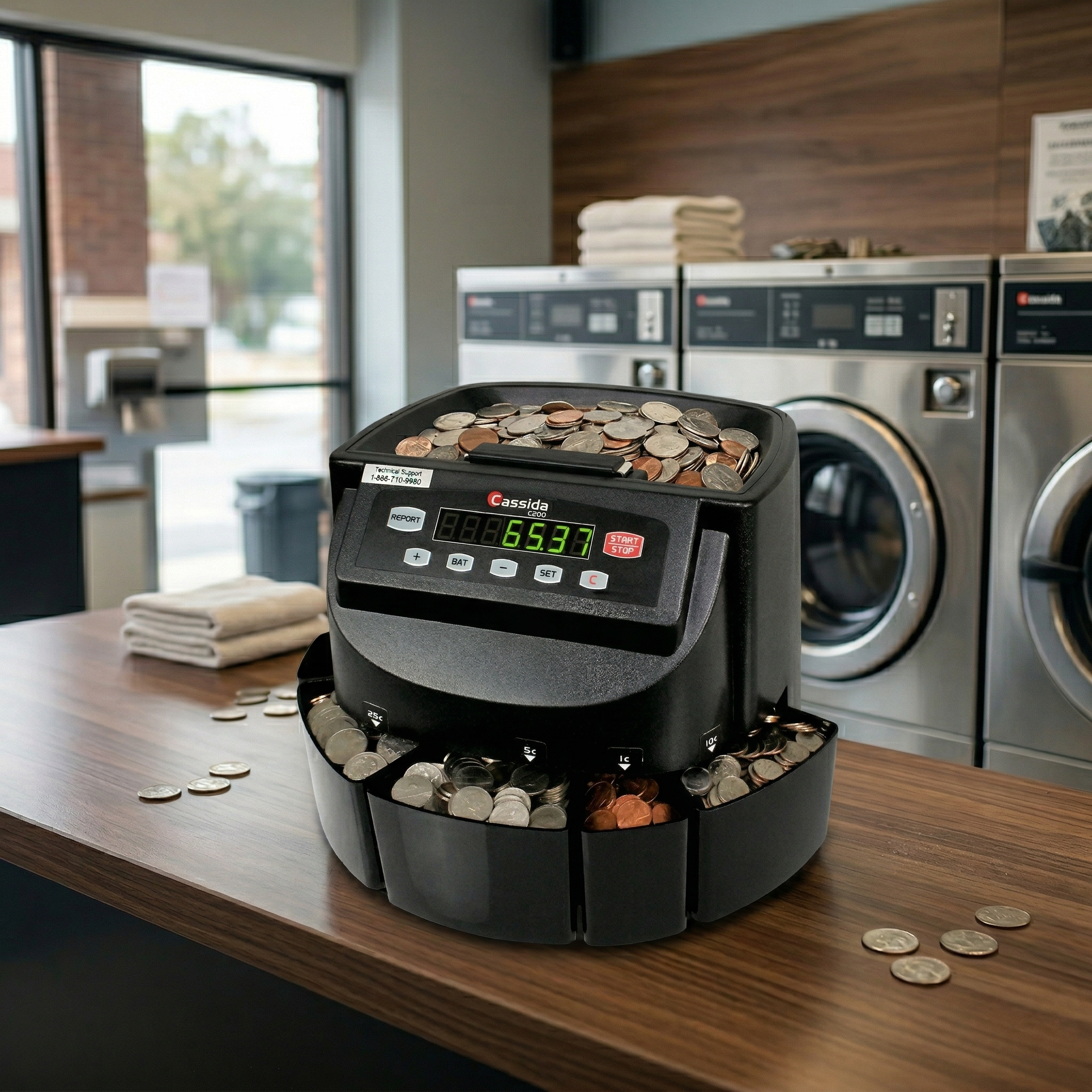
For businesses that handle coins - laundries, arcades, parking operations - coin counters and sorters batch directly into deposit-ready quantities, cutting coin deposit prep from a manual chore into a machine-driven process.
The result: cash moves from the till to the bank faster, with verified totals at every step.
The Real Cost: Add It Up
Here's an illustrative picture of what manual cash counting can cost a business processing around AED 15,000/day in cash:
|
Hidden Cost |
Illustrative Annual Estimate (AED) |
|
Counting labor (1x daily) |
10,000 – 15,000 |
|
Counting errors (1% daily discrepancy) |
40,000 – 55,000 |
|
Counterfeit losses (occasional notes) |
2,000 – 8,000 |
|
Overtime from recounts/long closes |
5,000 – 11,000 |
|
Deposit prep labor |
6,500 – 9,000 |
|
Total estimated annual cost |
63,500 – 98,000 |
A commercial bill counter from cassida.me costs between roughly AED 450 and AED 3,800, depending on the model and features. Even at the high end, the payback period is measured in weeks, not years.
The question was never whether your business can afford a bill counter. The question is how much you're already spending by not having one.
Frequently Asked Questions
#1. How much does manual cash counting actually cost per year?
It depends heavily on volume and frequency, but most cash-heavy businesses spend a meaningful sum annually on counting labour alone. Factor in error-related losses, counterfeit exposure, overtime, and deposit prep time, and the real number for a business processing significant daily cash comes in well into five figures (AED). Most owners have never calculated this because the costs are spread across labour, shrinkage, and operational inefficiencies rather than appearing as a single line item.
#2. What's the error rate for hand-counting cash?
Industry estimates put manual counting errors at 1–3% per session, depending on volume, denomination mix, and the counter's level of fatigue. Small day-to-day discrepancies are easy to ignore in the moment but compound into a significant sum over a year.
#3. Can a bill counter really pay for itself?
In most cases, within weeks. An entry-level Cassida counter starts at around AED 450. If it saves your business just 20–25 minutes per day in counting and deposit-prep labour, the labour savings alone typically recoup the cost within a month or two. Factor in error reduction and counterfeit detection, and the return multiplies from there.
#4. What size business needs a bill counter vs. hand-counting?
Any business regularly counting more than a modest daily cash volume will benefit from a counter. The practical threshold at which hand-counting becomes genuinely costly is roughly AED 3,000–5,000/day in cash volume - below that, an entry-level counter still saves time and improves accuracy, but the financial urgency is lower.
What's the difference between a bill counter and a mixed bill counter?
A standard bill counter counts one denomination at a time - you sort notes into stacks of AED 5s, 10s, 20s, 50s, and so on, then run each stack separately. A mixed bill counter accepts unsorted notes of any denomination, identifies each one automatically, and provides both a count and a full value breakdown in a single pass. Mixed counters cost more but eliminate the sorting step - the right choice for businesses where speed and unsorted drawer counts are the priority.
Key Takeaways
Manual cash counting isn't free. It costs your business a significant sum every year in labour, errors, counterfeit exposure, overtime, compliance gaps, and deposit prep time - costs that most owners have never added up because they're spread across a dozen different line items.
A commercial bill counter eliminates nearly all of those costs for a one-time investment that pays for itself faster than almost any other piece of equipment you own.
If your business handles cash, stop treating manual counting as "just part of the job." Calculate what it's actually costing you, then compare that to the price of the machine that eliminates it.