
Bill Counters for Gold & Jewellery Trading Houses in Dubai: Cash Handling & AML Compliance Guide
Deira's Gold Souk has around 300 to 380 shops packed into a few old streets, selling everything from 18-karat jewellery to 24-karat bars, all priced against the day's gold rate. The buyers come from all over - tourists from India, China, Russia, Europe, and the Gulf, plus a steady flow of local customers. Add the Gold & Diamond Park on Sheikh Zayed Road, the DMCC free zone in Jumeirah Lakes Towers, and the trading houses and refiners across the city, and Dubai handles a huge share of the world's gold trade. It is not only Dubai: the Sharjah gold souks and Abu Dhabi's Madinat Zayed gold centre run the same high-value, cash-heavy trade, and the VAT and AML rules below apply across the UAE, because they are set at the federal level.
What gets less attention is what happens at the counter after the gold changes hands. Someone has to count the cash, check it, record it correctly, and - depending on the amount - file a report before the day is out. Most shops use a bill counter (also called a money counter or currency counter) for this. But in gold, the machine you choose and the way you use it matter more than in almost any other kind of shop. This guide covers both sides: the daily counting job, and the UAE rules - VAT, AML reporting, and tourist refunds - that make gold different from normal retail.
A fake ₹500 note at the counter: what one Gold Souk trader changed
Anvar Luxury is a well-known gold shop in the main Gold Souk, selling 18–24K jewellery and bars. Because of where it sits, it gets a lot of Indian buyers, and many pay in USD and INR.
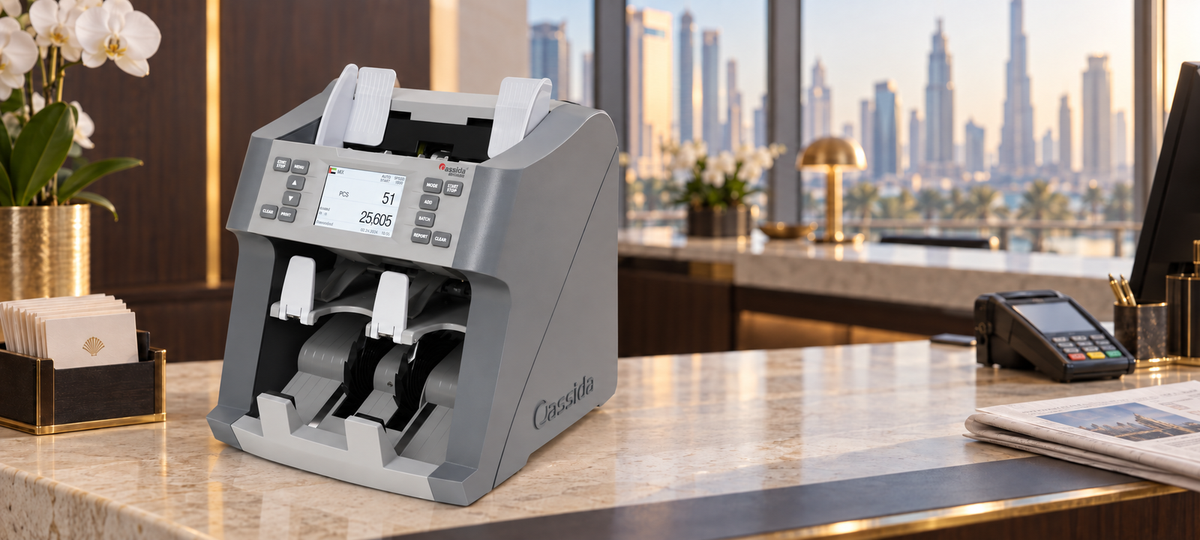
On one sale for gold bars paid partly in Indian rupees, their Cassida Neo Max caught three counterfeit ₹500 notes in the stack. The machine flagged them during the count, and the shop handed them straight back to the customer - before they became the shop's loss. After that, they made it a rule: every note that comes across the counter goes through a machine, no exceptions. On a floor where one sale can be tens of thousands, that single habit is the difference between catching a fake and losing the money for good.
Why a gold counter is not a normal shop counter
A normal shop till counts a few notes per sale. A Gold Souk counter might run a stack of AED 500s and 1,000s through the machine for one necklace, do it again for the next customer, and then value a foreign-currency stack an hour later when a tourist pays in USD or EUR. Three things make this harder than normal retail:
The amounts are high. A small piece can be a few thousand dirhams; a serious buyer can be tens of thousands. That puts a lot of risk into one sale, which a grocery store never sees - so an accurate counter matters more here.
The price is never round. Gold is priced by weight against the daily rate, plus making charges, plus VAT on the total. The invoice is rarely a clean number, so the count has to match an exact figure, not a rough one.
Buyers are international and pay a lot in cash. Tourists buying gold as a gift or an investment often pay in cash - their own currency or dirhams from an ATM. That is where a multi-currency counter pays off.
What is inside the invoice: VAT, making charges, and investment gold
Before a total means anything, it helps to know what is inside the number on the invoice, because the two main kinds of gold are taxed very differently. A AED 10,000 necklace made of AED 8,500 in gold and AED 1,500 in making charges has AED 500 in VAT on top, for a AED 10,500 total - and that is the figure the count has to match exactly. Investment-grade gold (99%+ pure, in tradable form like bars and coins) is zero-rated, so no VAT applies to it at all.
The AED 55,000 rule every gold trader must know
This is the most important compliance rule for gold trading in the UAE, and every shop - from a single Gold Souk counter to a large wholesale desk - needs its staff to know it.
Under Cabinet Resolution No. 134 of 2025 (Article 3(3)), dealers in precious metals and stones - jewellers, gold traders, bullion dealers, and refiners - must file a report (a DPMSR) through the goAML portal to the UAE Financial Intelligence Unit for any cash sale, or linked cash sales, of AED 55,000 or more. It applies to residents, tourists, and companies, and it covers instalments and advance payments too, not just one lump sum. A few points matter in practice:
It counts linked sales, not just single ones. Several connected purchases by the same buyer, close together, that add up past AED 55,000 still count - even if no single receipt crosses the line. Splitting a sale to stay under the limit is itself a warning sign regulators look for.
It is a reporting trigger, not a limit. There is no rule against a cash sale over AED 55,000; you just have to identify the buyer, keep the paperwork, and file the report.
You must check ID. The report needs the buyer’s ID (Emirates ID or passport for a person; trade license and rep ID for a company), so your sales process has to capture that at the point of sale.
You have two weeks from the day the cash comes in to file.
Some payments are exempt: cards, cheques, and bank transfers with individuals whatever the amount, and old-gold swaps where no cash crosses the limit.
This is where a machine-checked, recorded count really earns its place. If a sale crosses AED 55,000, you want a machine total behind what you report, not a hand count - and if the machine records serial numbers, that adds a clear trail if the sale is ever questioned. AML rules change from time to time (most recently under Cabinet Resolution No. 134 of 2025), so check the current rules with a qualified compliance advisor rather than treating any number as fixed. For now, AED 55,000 is the number every counter staff member handling big cash sales should know by heart.
International buyers: foreign currency and the tourist VAT refund
Tourists are a big part of Gold Souk traffic, and the UAE tourist VAT refund, run through Planet Tax Free, is a real part of the buying choice. A visitor who spends at least AED 250 at a registered shop and takes the goods out of the country within 90 days can claim the VAT back. The tax authority keeps 13% of the VAT plus AED 3.60 per transaction, so a tourist gets back about 87% of the VAT. Normal jewellery, taxed at 5%, is refundable; investment-grade gold is already zero-rated, so there is nothing to refund on it - worth explaining to buyers who think every gold purchase qualifies.
For your own cash handling, the point is simple: with so many foreign buyers, foreign notes show up far more often than in normal retail. Guessing a rate by hand, or sending a customer to an ATM, is slower and a worse experience than running a mixed AED/foreign stack through a currency counter that values several currencies at once. A multi-currency counter removes that hassle, and a screen lets the customer see exactly what they are paying, in the currency they handed over - which builds trust on a sale this size.
New polymer notes and the big-note problem
Here is something specific to the UAE right now. Since 2021 the Central Bank has been bringing out a new set of dirham notes, switching from paper to polymer, one note at a time. The new AED 1,000 note came into normal use in early 2023, and the AED 500 followed in late 2023. Old and new versions of each note are both legal at the same time during a long changeover, and the Central Bank has told banks and exchange houses to update their machines to read the new notes.
This matters more for gold than for almost any other business, because AED 500 and AED 1,000 notes - the two most affected by the change - are exactly the notes that pile up at a gold counter. A machine whose note database has not been updated may misread or reject real big notes right where a miscount costs the most. Every Cassida machine already reads all versions of the new polymer AED notes, old and new, so you will not turn away a real AED 500 or 1,000 at the counter. If you have not checked when your machine was last updated, this is a good week to do it.
Counterfeit risk where the stakes are highest
Counterfeiters go after big notes for a simple reason: the payoff per fake is bigger. A gold counter handles more AED 500s and 1,000s per sale than most businesses, so the risk is higher - and, as Anvar Luxury found, foreign notes carry the same risk. One counterfeit note on a big sale is a direct loss you cannot get back, and it eats straight into the day’s profit.
Looking at a note by eye is not a reliable check against good counterfeits, especially when the counter is busy. Automatic UV, magnetic, and infrared checks - standard on a good bill counter, with image-based (dual-CIS) checks on mixed-value models - check every note during the count, without adding a slow manual step while a customer waits.
SIRA security and where counting fits
Gold and jewellery shops in Dubai need approval from the Security Industry Regulatory Agency (SIRA), which checks the shop for the security standards needed to hold high-value goods - proper safes, alarms, and cameras among them. Cash handling is not the main focus of a SIRA check, but it fits alongside it: a fast, accurate, recorded count means cash spends less time sitting out on the counter, which is exactly the risk that physical security is there to reduce.
From count to compliance: one simple routine
Put together, a well-run gold counter needs a cash routine that does several things at once, not one after another:
Count and check against the right figure - gold value, making charges, and VAT together, not a rough guess.
Check for fakes automatically as part of the count, not as a separate manual step.
Take the buyer’s ID for any sale near AED 55,000, before the sale is finished.
Record the count, ideally with serial numbers for big sales, so the figure you report can be checked and does not rest on a handwritten note.
Secure and bank it quickly, so high-value cash does not sit on the premises.
Clean the machine regularly. Gold counters run a lot of notes, and cash is physically dirty - dust, grime, and oil build up inside and cause miscounts or jams over time, so the machine needs regular cleaning to stay accurate.
Matching the machine to your counter
Whether you run a stall in the Gold Souk, a shop in a gold center, or a wholesale desk in DMCC, three machines cover almost every case:
The everyday sales counter - Cassida Xpecto Lite: a reliable AED mixed-value counter that counts and values mixed AED denominations while automatically checking notes for counterfeits. It is ideal for jewellery counters where AED is the main currency handled.
Foreign-currency tourist payments - Cassida Xpecto: a multi-currency counter that counts and values a mixed stack of up to 20 currencies with no sorting, checks for fakes, and has a screen the customer can watch.
Big and back-office counters - Cassida Neo Max / Artemis: for a wholesale desk or any counter near the AED 55,000 limit, serial-number recognition records each note alongside the total - a clear record to sit behind a report, not just a number on a screen. This is the machine that caught the counterfeit notes at Anvar Luxury.
Key takeaways
Gold cash handling differs from normal retail in three ways: bigger sale amounts, prices that are never round (daily gold rate plus making charges), and an international, cash-heavy customer base.
Normal jewellery has 5% VAT on the full invoice (gold plus making charges); investment-grade gold (99%+ pure, tradable form) is zero-rated; sales between registered dealers usually fall under the reverse charge since 25 February 2025.
Any cash sale, or linked cash sales, of AED 55,000 or more means a report to the UAE FIU through goAML, plus buyer ID, within two weeks.
Tourists get back about 87% of the VAT they paid (after a 13% fee plus AED 3.60 per transaction), if they spend at least AED 250 and take the goods out within 90 days.
The switch to new polymer notes mainly affects the AED 500 and 1,000 notes used most in gold - keep your machine’s note database up to date.
Build counting, fake-checking, ID, and recording into one routine instead of treating compliance as a separate step.
Frequently asked questions
Do I have to report every cash sale to the FIU? No - only cash sales, or linked cash sales from the same buyer, of AED 55,000 or more. Below that, normal risk-based checks still apply, but the required report is triggered at AED 55,000.
What counts as a “linked” sale? Several purchases by the same buyer, close together, that together cross the limit even if no single receipt does. Breaking a sale into smaller amounts to stay under it is a known warning sign, not a way around the rule.
Is there VAT on investment-grade gold bars and coins? No. Gold that is 99%+ pure and in tradable form (bars, ingots, qualifying coins) is zero-rated. Normal jewellery - 18K, 21K, 22K - has 5% VAT on the full invoice, including making charges.
Can tourists claim back VAT on gold jewellery? Yes, if the purchase is at least AED 250 at a Planet Tax Free shop and taken out of the country within 90 days. Tourists get about 87% of the VAT back after fees. Investment-grade gold has no VAT to refund.
Why does the new banknote rollout matter for gold traders? Because old and new versions are legal at the same time during the changeover, and gold sales use the AED 500 and 1,000 notes most - the two most affected. Your machine needs an up-to-date database to read every version in circulation.
What is the difference between a bill counter and a money counter? In the UAE the terms mean the same thing - both count and total notes. Some models add currency detection (a “currency counter”) to value mixed foreign stacks, and fake detection (UV/MG/IR), which matters more at a gold counter than in normal retail.
Why gold traders switch to Cassida
Plenty of traders first buy a counter from a shop or an online marketplace, then have nowhere to turn when it fails in the middle of a busy day or starts rejecting real notes. They switch to Cassida because we run the region’s only dedicated service center for cash machines, in Al Quoz, Dubai - so a machine is cleaned, fixed, or replaced fast, not left broken at the counter.
About Cassida Middle East
Cassida Middle East is the only branch of Cassida USA in the region. We operate the UAE’s only service center focused exclusively on cash-handling equipment - banknote counters, sorters, and counterfeit detectors - located in Al Quoz, Dubai. We have been here since 2013 and have served more than 4,000 businesses across the country. Every machine has one year of warranty as standard; order directly on the Cassida website and you get an extra year on top - two years in total. You also get training when you buy and both on-site and yearly service plans.
Written by Mr. Aleksandr Popov, Commercial Manager, Cassida Middle East - 15 years of experience in cash handling.
Message us on WhatsApp, email, or call to book a demo at our Dubai showroom.