

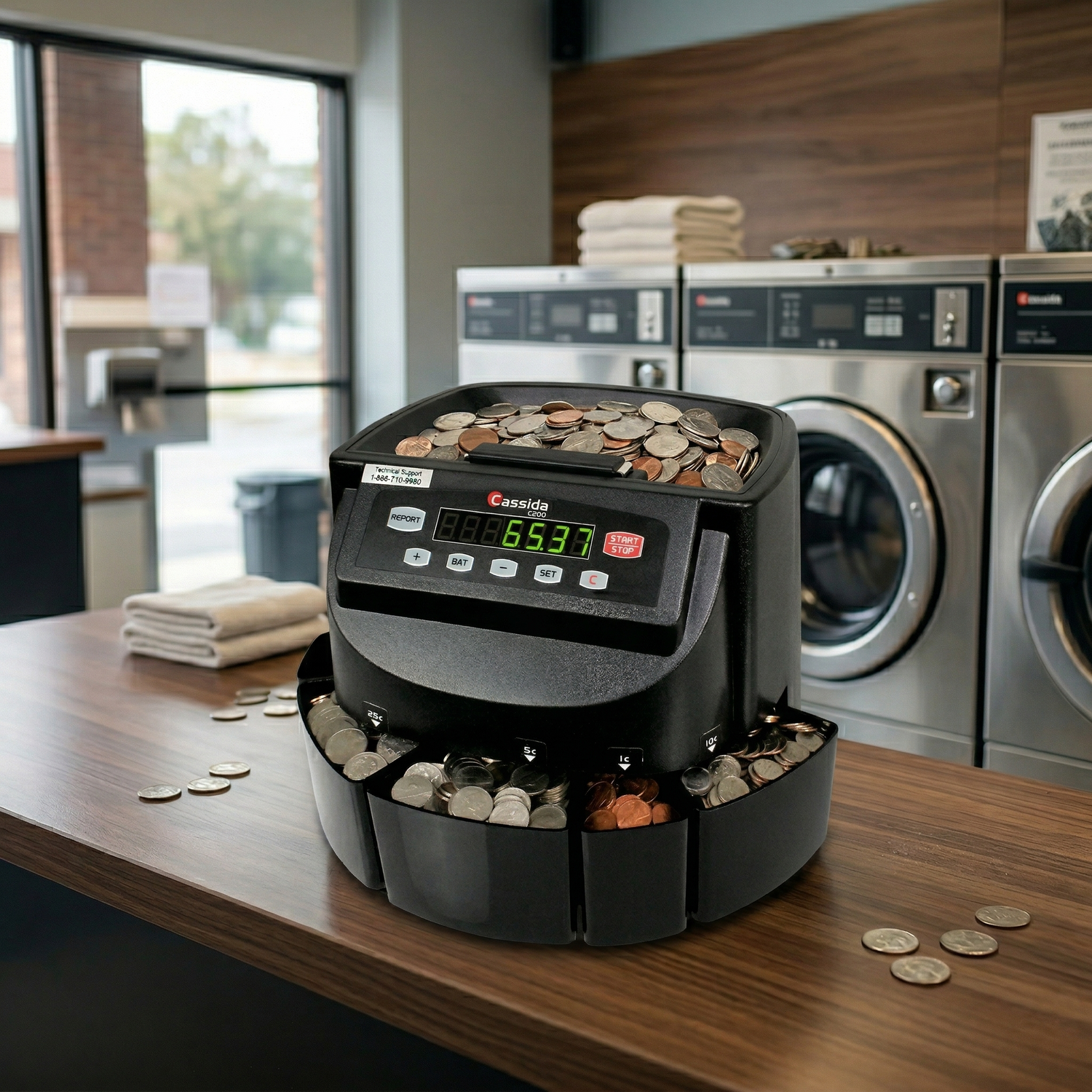
Laundromat owners lose hours every week hand-counting quarters from machine vaults – a tedious process that invites miscounts, slows down deposits, and makes it nearly impossible to spot revenue discrepancies before they become real problems.
When you can't trust your coin totals, you can't trust your financials. Shrinkage goes undetected, employee theft hides in the margins, and tax season becomes a guessing game.
An automated coin counter paired with the right collection routine turns a multi-hour chore into a 15-minute process – with totals you can actually bank on.
In this guide, we’ll show you seven coin-counting tips for laundromats that turn a messy manual process into a fast, auditable routine.
#1. Invest in a Commercial-Grade Coin Counter
The single biggest upgrade a laundromat owner can make to their coin-handling process is switching from manual counting to a commercial coin counter and sorter designed for daily use.
Entry-level coin counters jam constantly, miscount when hoppers are full, and break down within months under the kind of volume a laundromat generates. A location running 30-50 machines can easily pull $1,000-$3,000+ in quarters per week. That's thousands of coins flowing through the counter every collection day.
Commercial-grade machines like the Cassida C200 or Cassida C500 are purpose-built for this kind of volume. The C200 counts and sorts at 300 coins per minute with a 2,000-coin hopper - enough to process a typical single-location collection in one or two loads. The C500 steps up to 2,000 coins per minute with a 4,000-coin hopper, making it a better fit for high-volume locations or multi-site operators who need to blast through collections quickly.

For laundromats processing heavy daily volume across multiple locations, the Cassida C850 is the heavy-duty option – counting up to 1,900 coins per minute with a massive 6,500-coin hopper and a dual-motor design that virtually eliminates jams. It also works with tokens, which is a major plus for laundromats that run token-based systems.

The right machine pays for itself within weeks, just from the time it saves you. But more importantly, it gives you a verifiable count for every single collection, which matters for everything from bank deposits to theft prevention to tax reporting.
#2. Set a Consistent Collection Schedule and Stick to It
One of the most common mistakes laundromat owners make is collecting coins on a random or "whenever I get around to it" schedule. Inconsistent collection creates three problems at once.
First, overfull coin vaults can jam machines, taking them out of service and costing you revenue during peak hours. Second, irregular schedules make it impossible to track weekly revenue trends or spot anomalies – if you collect every five days one week and every nine days the next, your numbers are useless for comparison. Third, a predictable but not public schedule helps with security. Varying your exact collection time while keeping to regular intervals (twice a week, for example) prevents patterns that could make you a target.
For most single-location laundromats, collecting twice per week works well – once midweek and once on the weekend. High-traffic locations may need daily collection. Whatever frequency you choose, log every collection with the date, time, and total amount counted. Your coin counter's ‘Add’ mode makes running totals easy, and machines like the Cassida C300 can pair with a thermal printer to generate a receipt for every session, creating a paper trail that ties directly to your deposit records.
#3. Count at the Location, Not at Home
It's tempting to bag up coins at the laundromat and bring them home to count later. Don't.
Counting on-site immediately after collection creates a closed loop – you pull the coins from the machines, count them on the spot, and record the total before anything leaves the building. If someone else handles coin collection for you, this is especially critical. There's no window for coins to "go missing" between the vault and the counter.
Set up a small counting station in your back office or utility room. A compact counter like the Cassida C200 has a built-in carrying handle and fits easily on a desk or shelf. Pair it with a lockable coin bag, a logbook (or a spreadsheet on your phone), and you have a complete on-site counting station that takes up almost no space.
If you operate multiple locations, a portable machine like the Cassida C500 lets you move your counting operation from store to store with its compact design and built-in handle.
#4. Use Batch Mode to Prep Bank Deposits Faster
Most laundromat owners count their coins, bag them, and head to the bank. But if you're just dumping loose coins into a bag, you're making extra work for yourself at the teller window – and some banks charge fees for unsorted coin deposits or require rolled coins altogether.
Every Cassida coin counter – from the C100 to the C850 – includes a Batch mode that lets you set a specific coin count per run. Set it to 40 (the standard roll quantity for quarters), and the machine stops automatically when it hits that number. Load a coin wrapper onto the coin tube, and you've got a deposit-ready roll without counting a single coin by hand.
The Cassida C300 takes this a step further with its QuickLoad coin tube system, which lets you swap a full roll for the next wrapper without removing the tube from the machine. For a laundromat processing hundreds of dollars in quarters every few days, this shaves real time off the wrapping process.
Rolling your coins before deposit has a few practical benefits beyond bank convenience. Rolled coins are easier to transport securely, they're pre-verified by your machine's count, and they give your bank no reason to recount or question your totals.
#5. Track Revenue Per Machine, Not Just Totals
Counting your total weekly coin haul tells you how much your laundromat made. But it doesn't tell you which machines are performing and which ones are costing you money.
If you collect from each machine (or at least each machine type - top loaders, front loaders, dryers) into separate containers before running them through your counter, you can track revenue at a much more granular level. The Report mode on machines like the Cassida C200 and C300 displays total coins counted and total dollar value by denomination, making it easy to log per-machine or per-group totals.
This data reveals patterns that aggregated totals hide. A washer that's consistently pulling in 30% less than identical machines next to it probably has a mechanical issue customers have noticed but haven't reported. A dryer section that's outearning the wash section might signal you need more dryer capacity. Revenue-per-machine tracking turns your coin count from a bookkeeping task into an operational intelligence tool.
#6. Clean Your Coin Counter Weekly - Laundromat Coins Are Dirty
This is the tip most laundromat owners skip until their machine starts miscounting or jamming.
Coins from laundromat machines are among the dirtiest in commercial cash handling. They've been sitting in pockets, running through wash cycles, picking up lint and detergent residue, and collecting moisture. All of that debris accumulates inside your coin counter's sensors and pathways, gradually degrading accuracy and causing jams.
Cassida recommends weekly cleaning for any machine in regular commercial use, and laundromats should take that recommendation seriously. The Cassida Cleaning Kit includes everything you need – an air duster, cleaning swabs, cleaning cards, a dust cover, and a cleaning cloth. A five-minute cleaning session once a week prevents the kind of sensor buildup that leads to E1-E9 error codes and inaccurate counts.

For the C500 and C850, pay special attention to the coin thickness adjustment mechanism. Bent, corroded, or debris-coated coins are common in laundromat collections, and the thickness gauge is your first line of defense against jams and miscounts. Keeping it clean and properly calibrated ensures your machine rejects bad coins without stopping the count.
#7. Use Off-Sorting to Catch Bad Coins Before They Recirculate
If your laundromat has a change machine, you're likely recirculating quarters from your vaults back into the changer. That's efficient, but only if you're filtering out damaged, bent, or foreign coins first.
Bad coins are the number one cause of jams in washers and dryers. A bent quarter that slips through the collection and into your change machine will eventually end up in a customer's hand, then into one of your washers, where it jams the coin acceptor and takes that machine offline until you can clear it. Every out-of-service machine costs you revenue.
The Cassida C500 and C850 both feature an Off-Sort mode that filters out coins that don't meet the denomination's size and thickness parameters. Run your quarters through the counter with Off-Sort enabled, and the machine automatically rejects anything that doesn't pass - bent coins, foreign coins, slugs, and damaged quarters all get diverted to a separate reject bin. What comes out the other side is clean, verified, machine-ready currency.
The C850 also includes an adjustable coin thickness setting, giving you even finer control over what gets accepted. If your machines are particularly sensitive to slightly worn quarters, you can tighten the tolerance to reject anything borderline.
This one step - filtering coins before recirculation - can dramatically reduce machine downtime and service calls. It's one of the highest-ROI habits a laundromat owner can build into their collection routine.
Frequently Asked Questions
#1. Do laundromats really need a coin counter?
Any laundromat collecting more than a few hundred dollars per week in coins will save significant time with a commercial counter. A location pulling $1,500 in quarters per week is handling roughly 6,000 coins, and counting that by hand takes an hour or more and invites errors. An entry-level machine like the Cassida C200 processes that volume in under 25 minutes with verified totals. Most laundromat owners recoup the cost of the machine within a month or two through time savings alone, and the improvement in accuracy pays dividends at tax time.
#2. What's the best coin counter for a small laundromat?
The Cassida C300 is the sweet spot for small to mid-size laundromats. It counts and sorts at 300 coins per minute, holds 2,000 coins in the hopper, and adds a big report screen, printing capability, and convenient magnetic tubes. Count, Batch, Add, and Report modes make it easy to manage collections efficiently, and the coin bins hold up to 900 coins each, with sorting directly into coin tubes for wrapping. At its price point, it’s purpose-built for single-location owners who collect a few times per week and offers excellent value for just $20 more than the C200.
#3. What's the best coin counter for a large or multi-location laundromat?
The Cassida C850 is designed for high-volume operations. Its 6,500-coin hopper and 1,900 coins-per-minute speed handle even the heaviest collection days without slowing down. The dual-motor hopper design prevents jams – a critical feature when you're processing thousands of laundromat coins that tend to carry lint, residue, and damage. The Off-Sort mode and adjustable thickness gauge also make it the best option for owners who recirculate quarters through change machines.
#4. How often should I clean my coin counter?
Weekly, at a minimum. Laundromat coins carry more debris than typical commercial coins because they are exposed to water, detergent, lint, and pocket contents. Dirty sensors are the most common cause of counting errors and error codes on coin counters. A quick cleaning with the Cassida Cleaning Kit takes about five minutes and keeps your machine running accurately. If you're processing very high volumes or notice increased jams, consider cleaning twice per week.
#5. Can I use a coin counter with tokens?
Yes, the Cassida C500 and Cassida C850 work with most standard tokens, as well as U.S., Canadian, and Mexican coins. If your laundromat runs a token-based payment system, these machines let you count and sort tokens alongside regular coins. Use the Off-Sort feature to separate tokens from standard currency during collection.
#6. Should I roll coins or deposit them loose?
It depends on your bank's policy. Some banks accept loose coins in bags with a verified count, while others require or prefer rolled coins. Rolling gives you a verified, pre-counted deposit that's harder for the bank to dispute, and it's faster at the teller window. Every Cassida coin counter includes a Batch mode that stops at standard roll quantities, and models like the C200 and C300 sort directly into coin tubes with coin wrappers for quick rolling. If you're depositing more than $500 per trip, rolling is almost always worth the extra few minutes.
Key Takeaways
A coin counter is one of the fastest-returning investments a laundromat owner can make - saving hours per week, producing verifiable totals for every collection, and catching bad coins before they jam your machines.
For smaller operations, the Cassida C300 delivers reliable counting, sorting, and wrapping at a price that makes sense for single-location owners.
High-volume and multi-location operators should look at the Cassida C500 or Cassida C850 - machines built to handle thousands of coins per session with Off-Sort capability that keeps your change machines fed with clean, verified quarters.
Pair any counter with a consistent collection schedule, on-site counting, per-machine revenue tracking, and weekly cleaning, and you'll turn the most tedious part of laundromat ownership into one of the most dialed-in systems in your business.