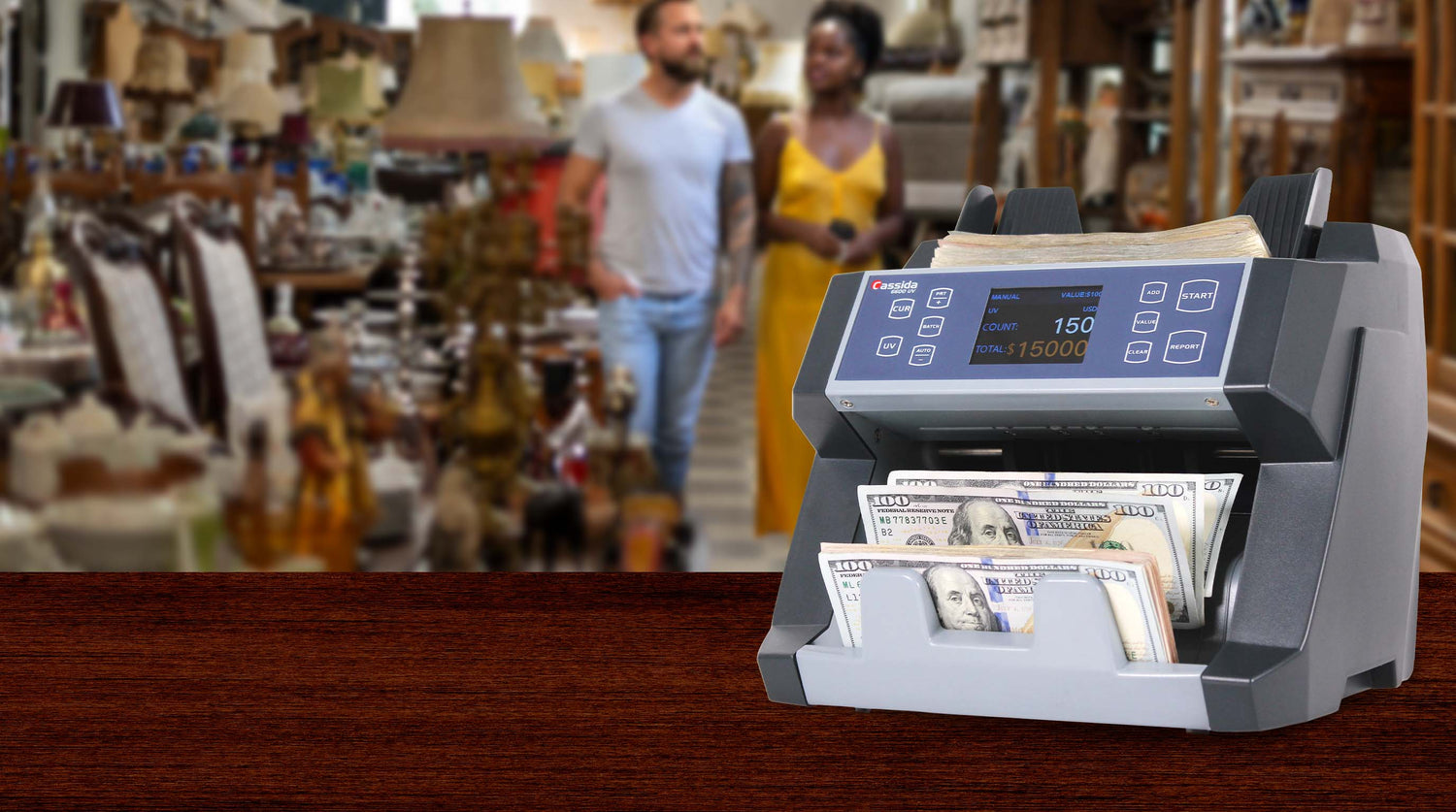
Pawn shops run on cash, and counting it by hand is slow, error-prone, and leaves you wide open to counterfeit losses.
A single fake $100 bill can eat into your daily margins fast, and miscounts during loan payoffs or buybacks create disputes that damage customer trust.
The fix is a commercial-grade bill counter with built-in counterfeit detection – a machine that pays for itself within weeks and keeps your cash drawer airtight.
Below, we compare the three best bill counters for pawn shops to help you choose the right machine for your volume, risk level, and budget.
|
Feature |
Cassida 5520 UV/MG |
Cassida 6600 UV/MG |
Cassida 8800R V2 |
|
Best for |
Budget-conscious shops |
Most pawn shops (best overall) |
High-volume operations |
|
Counting speed |
1,300 bills/min |
1,400 bills/min |
800-1,000 bills/min (adjustable) |
|
Hopper capacity |
250 bills |
400 bills |
500 bills |
|
Counterfeit detection |
UV, MG, IR |
UV, MG, IR |
UV, MG, IR, 2CIS |
|
Mixed denomination |
No (ValuCount per denom) |
No (ValuCount per denom) |
Yes - automatic |
|
Display |
LCD |
2.8" TFT color |
3.5" touchscreen TFT |
|
Warranty |
1 year |
1 year |
3 years |
|
Price (MSRP) |
$216 |
$266.99 |
$789.99 |
3 Best Bill Counters for Pawn Shops
#1. Cassida 5520 UV/MG - Best Budget-Friendly Option for Small Pawn Shops

The Cassida 5520 UV/MG is the ideal entry point for pawn shops with moderate daily cash volume and no need for mixed-denomination sorting. It counts up to 1,300 bills per minute and packs UV and magnetic ink (MG) counterfeit detection into a compact, portable frame with a built-in carry handle.
What makes it optimal for pawn shops is the ValuCount feature. Select a single denomination, and the 5520 calculates the total dollar value of every bill counted - perfect for verifying loan payoffs and cash drawer totals at shift changes. Count, Batch, and Add + Batch modes let you organize bills into preset stacks for bank deposits or strap bills for your safe.
Infrared sensors automatically detect half-notes, double bills, and chain notes. When the machine flags a problem, it stops, beeps, and displays the error type on its high-resolution LCD screen, leaving no guesswork for your staff.
The 5520’s UV and magnetic detection provide an effective first line of defense against the most common counterfeits pawn shops encounter, particularly higher-denomination $50 and $100 bills. Because pawn transactions often involve larger cash payments and loan redemptions, having automatic counterfeit screening built into the counting process helps staff quickly verify bills without slowing the transaction at the counter.
Why pawn shops love it:
- Portable enough to move between the counter and the back office
- ValuCount eliminates mental math on denomination totals
- UV/MG detection catches the most common counterfeits targeting $50 and $100 bills
- Simple controls mean new employees learn it in minutes
- 1-year warranty with US-based support
Best for: Single-location pawn shops processing under $10,000/day in cash transactions.
#2. Cassida 6600 UV/MG - Best Mid-Range Counter for Busy Pawn Shops

The Cassida 6600 UV/MG steps up in both speed and detection power, counting up to 1,400 bills per minute through a convenient top-loading hopper. For pawn shops with steady foot traffic and higher daily cash volume, that extra speed and the larger 2.8-inch TFT color display make a real difference during rush periods.
The 6600 has the same reliable counterfeit detection as the 5520, using ultraviolet, magnetic, infrared, spectral, fluorescence, variable-ink, and security-line checks. Its top-loading hopper is a major upgrade over the 5520’s rear-loading system: bills can simply be dropped in, making high-volume counting faster and easier while reducing setup time and feeding errors.
Like the 5520, the 6600 includes ValuCount for single-denomination value totals, as well as Count, Batch, and Add + Batch modes. The top-loading design makes it faster to feed bills in rapid succession, which matters when you're counting out a large buyback or verifying a high-value loan redemption in front of a customer.
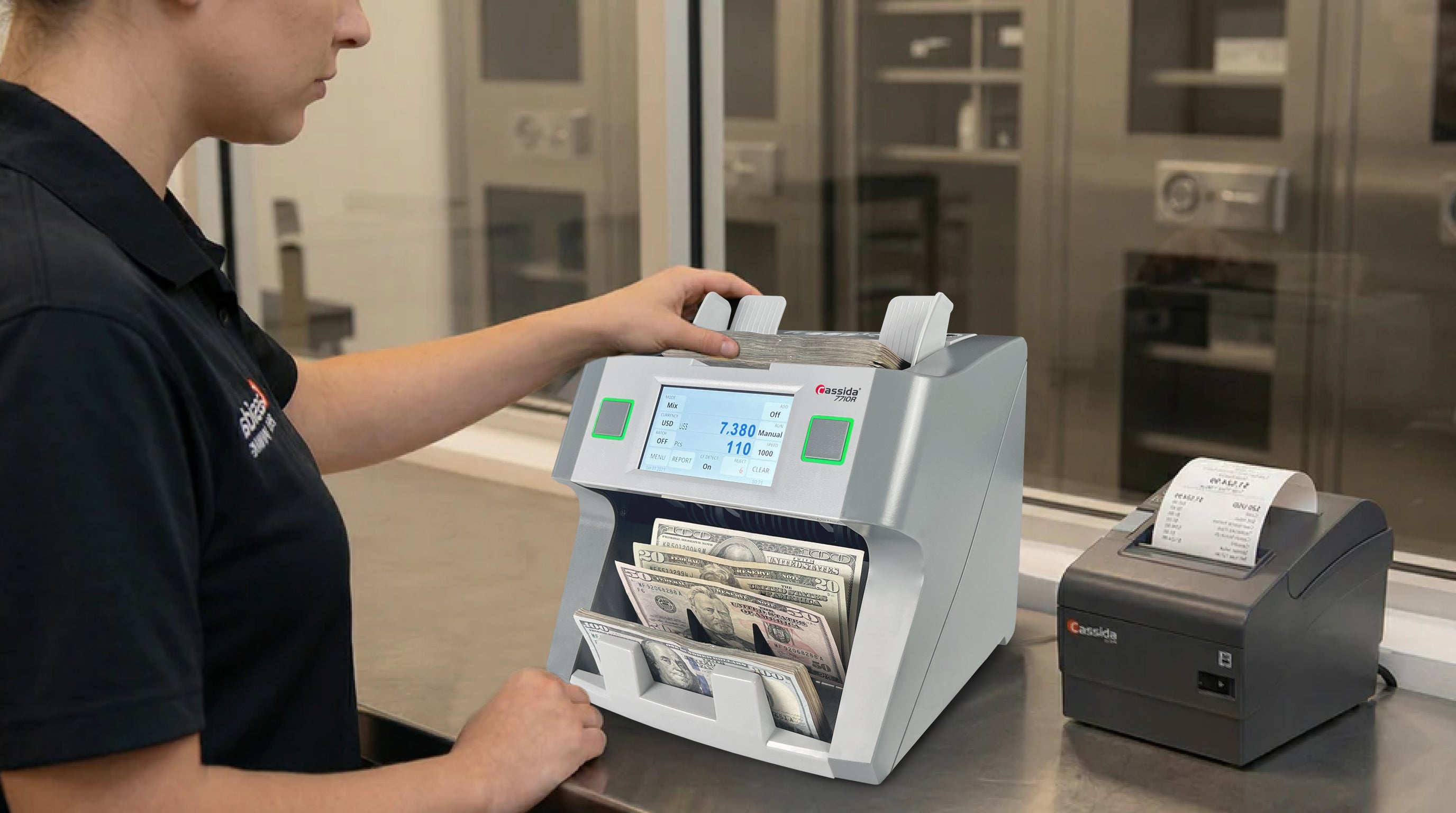
An optional printer connection lets you generate receipts for every count – useful for internal record-keeping, dispute resolution, and audit trails.
Why pawn shops love it:
- Top-loading design speeds up high-volume counting sessions
- Seven-layer counterfeit detection catches fakes that simpler machines miss
- The large color TFT display is easy to read from across the counter
- Optional printing for transaction records and end-of-day reports
- Auto and manual start modes for flexible workflow
Best for: Busy pawn shops handling $10,000–$30,000+ in daily cash, or multi-employee shops with a higher risk of counterfeit.
#3. Cassida 8800R V2 - Best Premium Mixed-Bill Counter for High-Volume Pawn Shops

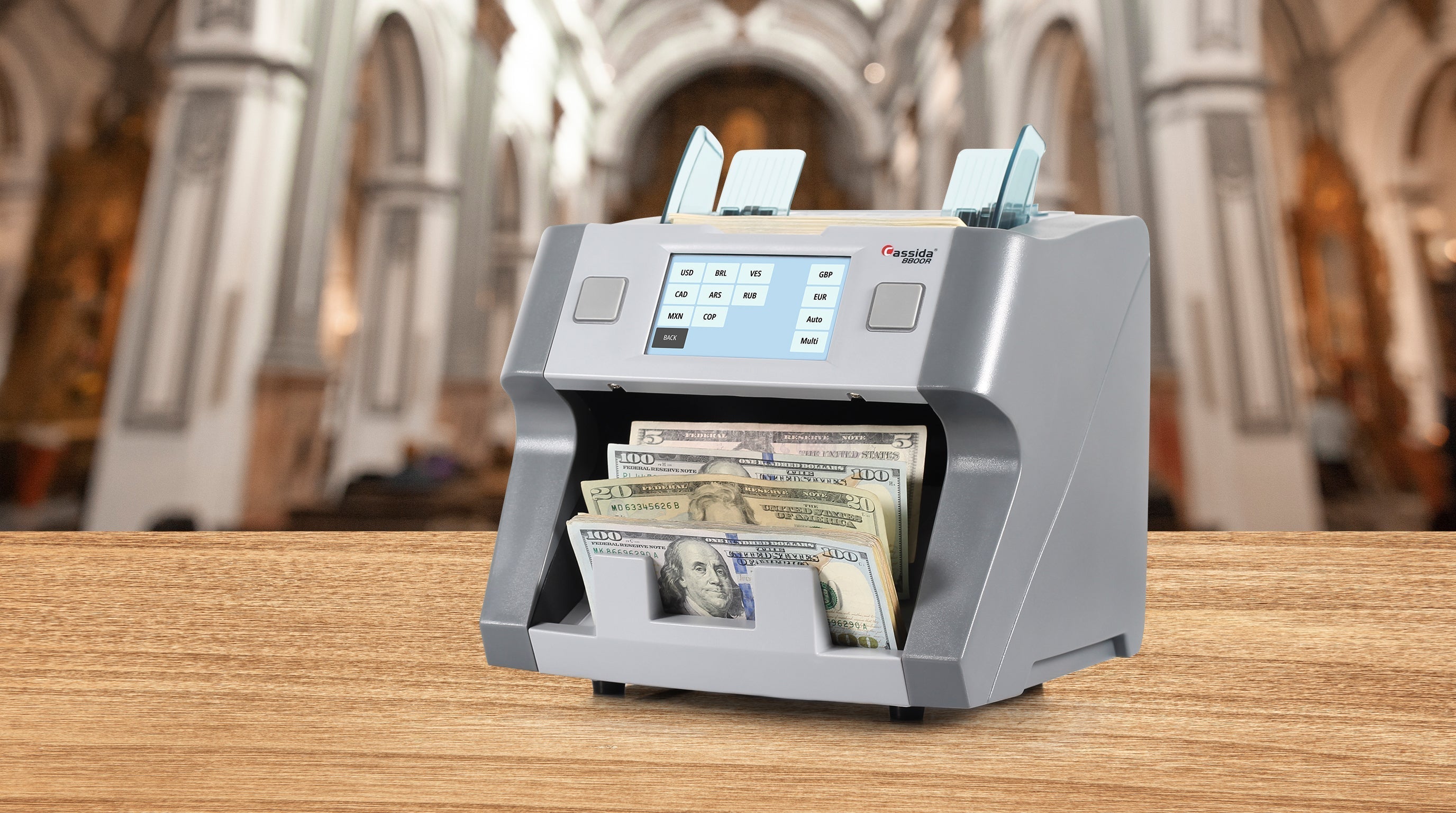
The Cassida 8800R V2 is a machine of a different class entirely. It's a mixed-denomination bill counter - meaning you dump an unsorted stack of $1s, $5s, $10s, $20s, $50s, and $100s into the hopper, and it automatically identifies every denomination, counts the total quantity, and calculates the total dollar value in a single pass.
For high-volume pawn shops, this eliminates the most time-consuming part of cash handling: pre-sorting. Instead of separating every denomination before counting, your staff just loads the hopper and lets the 8800R do the work. It sorts by denomination, face orientation, and bill direction, and it handles multiple currencies (USD, CAD, MXN, and more).
Counterfeit detection uses UV, MG, IR, and dual Contact Image Scanner (2CIS) technology – the same sensor suite found in bank-grade equipment. The 3.5-inch TFT touchscreen and touch-button navigation make it intuitive to operate, despite its advanced capabilities.
The Titan-II heavy-duty motor is built for shops that run thousands of bills per day without skipping a beat. It also includes an external customer-facing display – a feature pawn shop owners love because it lets the customer see the count happening in real time, reducing disputes before they start.
Why pawn shops love it:
- Mixed-denomination counting eliminates pre-sorting entirely
- External display builds customer trust during transactions
- Bank-grade 2CIS counterfeit detection catches even high-quality fakes
- Sorts by denomination, face, and orientation for organized deposits
- 3-year extended warranty with free lifetime professional support
- Handles multiple currencies for border-area pawn shops
Best for: High-volume pawn shops processing $30,000+/day, multi-location operations, or shops that also cash checks or handle multi-currency transactions.
5 Tips for Choosing a Pawn Shop Bill Counter
- Prioritize counterfeit detection over raw speed. Pawn shops see a wider variety of bill conditions and sources than most retail businesses. A machine with multi-sensor detection (UV + MG + IR at minimum) is non-negotiable – counterfeit pens alone are not reliable enough for the volume and risk level pawn shops face.
- Match the machine to your daily cash volume. A single-denomination counter works great if you're processing under $10K/day and don't mind pre-sorting. Once you're consistently above that threshold, a mixed-denomination counter saves enough labor time to justify the higher price tag within months.
- Look for batch counting and ValuCount features. Pawn shops constantly prepare bank deposits, verify cash drawers at shift changes, and count out loan payoffs. Batch mode lets you strap bills in preset quantities, and ValuCount gives you instant dollar totals without manual calculation, both saving significant time every single day.
- Consider a customer-facing display. Cash disputes are one of the most common friction points in pawn transactions. A machine with an external display lets the customer watch the count in real time, which dramatically reduces arguments over loan payoff amounts and buyback totals.
- Buy commercial-grade and factor in a warranty. Cheap home-office counters jam on worn or wrinkled bills – exactly the kind of currency pawn shops handle daily. Invest in a business-grade machine rated for thousands of bills per day, and ensure the warranty covers at least 1 year (ideally 3) with US-based support.
Frequently Asked Questions
#1. Do pawn shops need a bill counter with counterfeit detection?
Yes, they do – and it's arguably more important for pawn shops than most other businesses. Pawn shops handle cash from a wide range of sources, including loan payoffs, outright purchases, and walk-in sales.
This high-touch, high-volume cash environment makes pawn shops frequent targets for counterfeit bills, particularly in $50 and $100 denominations.
A bill counter with built-in UV, MG, and IR detection catches the vast majority of fakes automatically during the counting process, protecting your margins without slowing down transactions.
#2. What's the difference between a standard bill counter and a mixed-denomination bill counter?
A standard (single-denomination) bill counter counts the number of bills in a pre-sorted stack – all bills must be the same denomination.
A mixed-denomination counter uses advanced image recognition to automatically identify denominations ($1 through $100), count them, and calculate the total dollar value in a single pass.
Standard counters are more affordable and work well for shops that don't mind pre-sorting. Mixed counters save significant labor time for shops with high daily cash volume.
#3. How fast should a bill counter be for a pawn shop?
Most pawn shops do well with a counter in the 1,000-1,400 bills-per-minute range. That's fast enough to process a full cash drawer or a large loan payoff in under a minute.
Counters at 800 bills per minute work for very small operations, but anything below that creates bottlenecks during busy periods. The key is matching speed to your peak transaction volume, not your average volume.
#4. Can bill counters handle worn, wrinkled, or old bills?
Commercial-grade bill counters are designed to handle bills in mixed condition, including lightly worn and creased currency. However, heavily crumpled, torn, or taped bills can cause jams in any machine. Best practice for pawn shops is to flatten bills before feeding them and to set aside severely damaged notes for manual counting. Models with easy anti-jam access panels make clearing occasional jams quick and painless.
#5. How often do pawn shop bill counters need maintenance?
For a typical pawn shop, a quick weekly cleaning keeps the machine running accurately. Use canned air to blow out dust and lint from the sensors and bill path, and wipe the rollers with a soft cloth. High-volume shops that process thousands of bills daily should be cleaned every few days. Most commercial-grade counters last 5-10 years with regular maintenance, and many Cassida customers report their machines running well past 10 years.
#6. Are bill counters worth the investment for a small pawn shop?
Absolutely. Even a small pawn shop processing a few thousand dollars in cash daily will recoup the cost of an entry-level bill counter (around $200-$250) within weeks through time savings alone. Factor in the protection from even one counterfeit $100 bill, and the ROI becomes obvious. The real question isn't whether you can afford a bill counter - it's whether you can afford not to have one.
Key Takeaways
The right bill counter turns one of a pawn shop's biggest daily headaches into a non-issue.
For smaller shops on a budget, the Cassida 5520 UV/MG delivers reliable counting and solid counterfeit detection at an accessible price point.
Busier shops with higher cash flow benefit from the Cassida 6600 UV/MG's faster speed and deeper seven-layer counterfeit screening.
And high-volume operations that want to eliminate pre-sorting should look at the Cassida 8800R V2 - a true mixed-denomination machine with bank-grade detection and a customer-facing display that builds trust at the counter.
Whichever model fits your operation, the investment pays for itself fast and protects your bottom line every single day.