3 Best Bill Counters for Churches in 2026
Every Sunday, volunteers huddle in a back room hand-counting offering plates – a process that's slow, prone to error, and nearly impossible to audit.
Miscounts create uncomfortable conversations with church leadership, and without a paper trail, even honest teams are exposed to suspicion.
A commercial-grade bill counter delivers speed, accuracy, and verifiable counts to every offering, protecting both your church's finances and the volunteers who steward them.
|
Feature |
Cassida 5520 UV/MG |
Cassida 6600 UV/MG |
Cassida 8800R V2 |
|
Best for |
Small to mid-size churches |
Most churches (best overall) |
Large and mega churches |
|
Counting speed |
1,300 bills/min |
1,400 bills/min |
800-1,000 bills/min (adjustable) |
|
Hopper capacity |
250 bills |
400 bills |
500 bills |
|
Counterfeit detection |
UV, MG, IR |
UV, MG, IR |
UV, MG, IR, 2CIS |
|
Mixed denomination |
No (ValuCount per denom) |
No (ValuCount per denom) |
Yes - automatic |
|
Display |
LCD |
2.8" TFT color |
3.5" touchscreen TFT |
|
Warranty |
1 year |
1 year |
3 years |
|
Price (MSRP) |
$216 |
$266.99 |
$789.99 |
3 Best Bill Counters for Churches
#1. Cassida 5520 UV/MG - Best Budget-Friendly Counter for Small Churches

The Cassida 5520 UV/MG is the best alternative for churches with a single weekly service and a modest offering volume. It counts up to 1,300 bills per minute with UV and magnetic ink (MG) counterfeit detection built in - more than enough to process a typical Sunday collection in minutes rather than having your staff spend 30-45 minutes hand-counting bills.
The standout feature for churches is ValuCount. Your counting team sorts bills by denomination (which best-practice offering procedures already require), selects that denomination on the machine, and gets both a bill count and a total dollar value instantly. No calculators, no mental math, no discrepancies between counters. That's a huge win for volunteer teams who count once a week and need a foolproof process.
Count, Batch, and Add + Batch modes let your team organize bills for bank deposits - batch 25 twenties into a strap, run the next denomination, and let the Add mode keep a running total across all stacks. When the count is done, the number on the screen should match the deposit slip exactly.
Infrared sensors automatically detect half-notes, double bills, and chain notes. If something's off, the machine stops, beeps, and displays the error. Even first-time volunteers can operate it confidently.
Why churches love it:
- Compact and portable with a built-in handle - easy to store between Sundays
- ValuCount gives instant dollar totals per denomination for offering count sheets
- UV/MG detection flags counterfeit bills without slowing down the count
- Simple enough for rotating volunteer teams to learn in minutes
- 1-year warranty with US-based support
Best for: Churches with fewer than 300 members, with a single weekly service and one offering collection.
#2. Cassida 6600 UV/MG - Best Overall Counter for Most Churches

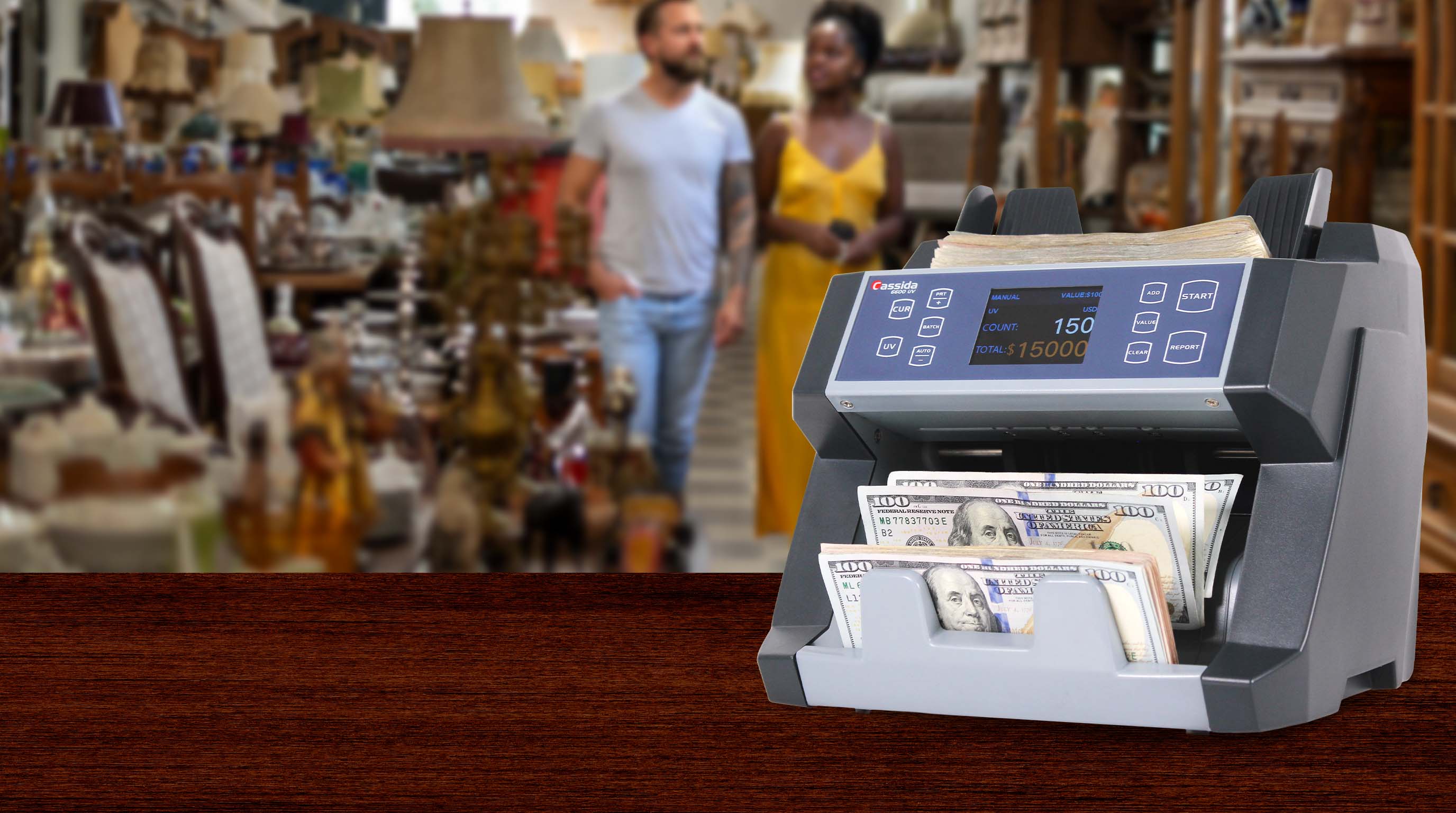
The Cassida 6600 UV/MG is the upgrade that makes sense for churches with multiple services, midweek offerings, or special events that generate higher cash volume. Counting at 1,400 bills per minute through a top-loading hopper, it saves real time off counting sessions - time your volunteers would rather spend with their families after a long Sunday.
What makes the 6600 particularly well-suited for churches is its depth of counterfeit detection. It runs seven layers of authentication: ultraviolet, magnetic, infrared, spectrum, fluorescence, variable-ink, and security-line detection. Churches are open-door environments - anyone can drop anything into an offering plate. That depth of screening protects your congregation's giving without requiring your counting team to inspect bills individually.
The 2.8-inch TFT color display is larger and easier to read than the 5520's LCD, which matters in a counting room where two or three volunteers need to see the screen simultaneously. ValuCount, Count, Batch, and Add + Batch modes all carry over from the 5520.
The optional printer connection is the real differentiator for churches focused on financial accountability. Print a receipt for every count session, attach it to your offering count sheet, and you've created an auditable paper trail that protects your counting team and satisfies your finance committee. For churches that have experienced financial scrutiny - or want to prevent it - this feature alone justifies the price difference.
Why churches love it:
- Top-loading design speeds up counting for multiple services or combined offerings
- Seven-layer counterfeit detection screens every bill automatically
- An optional printer creates auditable receipts for each counting session
- A large color display is easy for multiple counters to read at once
- Auto and manual start modes accommodate different volunteer workflows
Best for: Churches with 300-1,500+ members, multiple weekly services, or any church prioritizing financial transparency and audit trails.
#3. Cassida 8800R V2 - Best Premium Counter for Large and Mega Churches

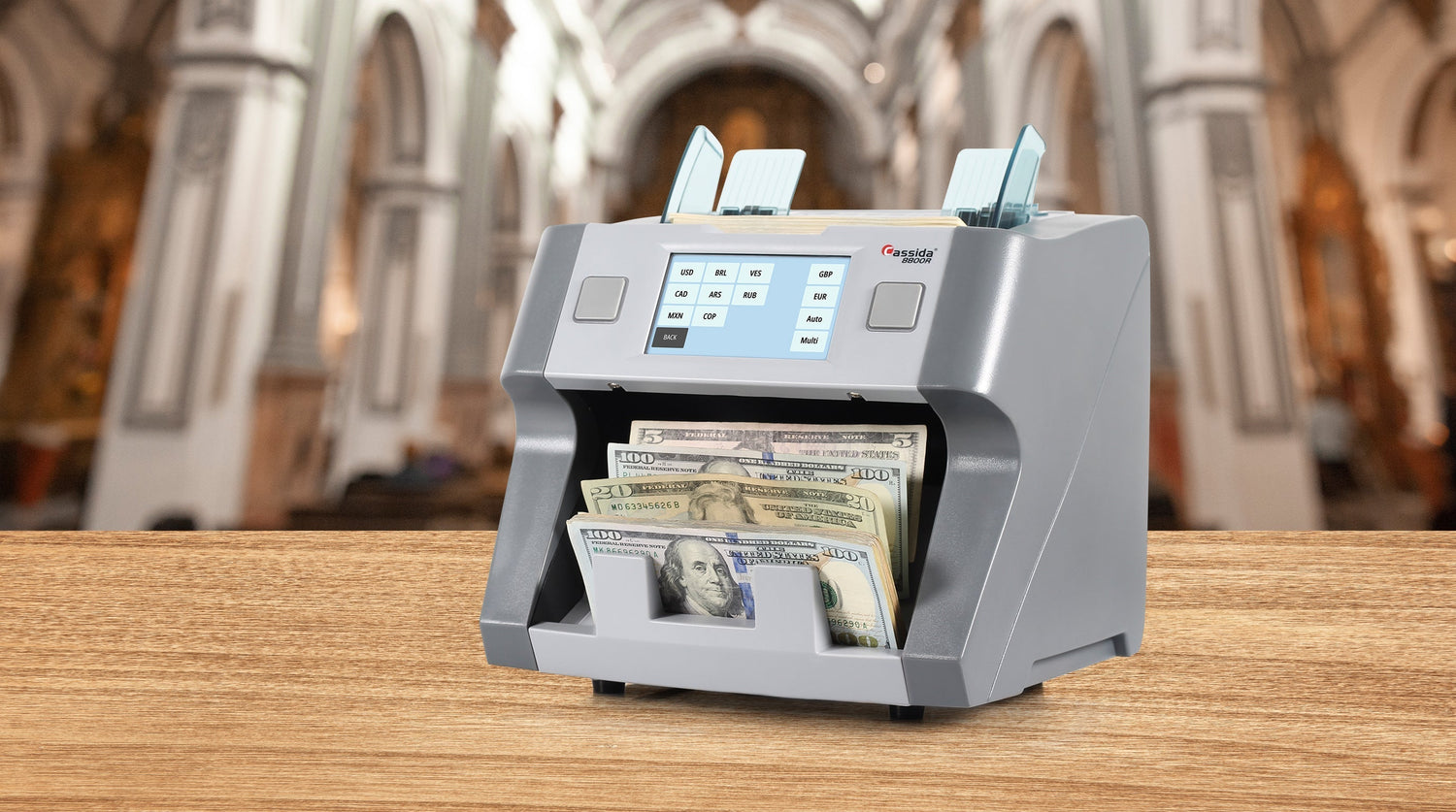
The Cassida 8800R V2 is built for churches where the Sunday offering fills multiple collection bags, and the counting room processes thousands of dollars across mixed denominations. As a mixed-denomination bill counter, it eliminates the sorting step - dump an unsorted stack of $1s through $100s into the 500-bill hopper, and the machine identifies every denomination, counts each one, and calculates the total dollar value in a single pass.
For large churches, this changes the math on volunteer time dramatically. A standard counter requires your team to sort all bills by denomination, count each stack individually, and then manually total everything. The 8800R V2 compresses that into one step. For a church processing $20,000+ in cash offerings across multiple services, that can save an hour or more every Sunday.
Counterfeit detection uses UV, MG, IR, and dual Contact Image Scanner (2CIS) technology - the same bank-grade sensor suite used in financial institutions. The machine also sorts by denomination, face orientation, and bill direction, producing organized stacks ready for deposit without additional handling.
The 6600’s top-loading hopper design makes the machine far easier for volunteer teams to use. Unlike the 5520’s rear-loading system, which requires users to place bills into the feeder in a specific way, the 6600 allows counters to simply place or drop the stack directly into the hopper from the top. This simple loading process makes a noticeable difference. It reduces setup time, prevents feeding errors, and keeps counting sessions moving quickly, even with large batches of offerings.
The 3.5-inch touchscreen TFT display and intuitive touch navigation make it approachable despite its advanced capabilities. Operational modes include Mix, Sort, Face, Orient, and more, giving your counting team the flexibility to process offerings however works best for your deposit procedures.
The Titan-II heavy-duty motor handles high-volume counting sessions without overheating, and the external display can be positioned to face your second counter for real-time verification, reinforcing the dual-custody accountability that church financial best practices require.
Why churches love it:
- Mixed-denomination counting eliminates the most time-consuming step in offering processing
- Bank-grade 2CIS counterfeit detection catches even sophisticated fakes
- Sorts and organizes bills by denomination for deposit-ready stacks
- External display supports dual-custody counting accountability
- 3-year extended warranty with free lifetime professional support
- Handles multiple currencies for churches with international congregations
Best for: Churches with 1,500+ members, mega churches, multi-campus operations, or any church processing $10,000+ in cash offerings per Sunday.
5 Tips for Choosing a Church Bill Counter
- Prioritize ease of use for volunteer teams. Unlike businesses with trained employees, most churches rely on rotating volunteers who count once or twice a month. Choose a machine with simple controls, clear displays, and intuitive operation so that any team member can run it confidently with minimal training.
- Match the machine to your typical offering volume. A small church collecting $500-$2,000 per service doesn't need a mixed-denomination counter. A standard counter with ValuCount handles that perfectly. Once you're regularly processing $5,000+ per service across mixed bills, the time savings of an auto-sorting machine start to make financial sense.
- Use the printer feature for financial accountability. Church financial fraud is a real and growing issue: 3 in 10 church leaders report that their congregation has experienced financial misconduct. A printed receipt from every count session, attached to a signed offering count sheet, creates the kind of paper trail that deters fraud and protects honest volunteers from suspicion.
- Get a machine with built-in counterfeit detection. Churches are open environments where anyone can contribute to an offering. Unlike a retail store, where staff can inspect bills at the register, churches typically discover counterfeits only during the count. Multi-sensor detection (UV + MG + IR) catches fakes automatically during counting, so your team doesn't have to eyeball every bill.
- Factor in portability and storage. Most churches don't have a permanent counting room with a dedicated countertop. Your bill counter will likely get moved to and from a closet, office, or safe room every week. Look for compact machines with built-in handles and lightweight construction, making them easy to store between services.
Frequently Asked Questions
#1. Do churches really need a bill counter?
Any church that collects cash offerings can benefit from a bill counter. Even small congregations save 20-30 minutes per count session, and the accuracy eliminates the discrepancies that create awkward conversations between counters and church leadership. As offering volume grows, the time savings multiply. Most churches recoup the cost of an entry-level counter ($200-$270) within a few months through the time volunteers save alone - time they can spend on ministry instead of manual counting.
#2. Should a church bill counter have counterfeit detection?
Yes. Churches are uniquely vulnerable because offerings are collected anonymously in open settings. Your counting team has no way to screen bills at the point of donation, the way a cashier would at a register. A counter with UV, MG, and IR detection automatically flags suspect bills during the counting process, protecting your church's funds without adding any extra steps for your volunteers.
#3. How does a bill counter help with church financial accountability?
A bill counter produces consistent, verifiable totals, eliminating human error. When paired with a printer (available on the Cassida 6600 and 8800R V2), it generates a receipt for every count session, creating a paper trail that supports your offering count sheets, meets audit requirements, and reinforces the dual-custody controls that church financial best practices recommend. This protects both the church and the volunteers who handle its money.
#4. Can volunteer teams operate a bill counter without training?
Commercial-grade counters like the Cassida 5520 and 6600 are designed for intuitive operation. Most volunteers can learn basic counting functions within minutes. The key features - Count, Batch, and ValuCount - require nothing more than loading bills and pressing a button. For rotating volunteer teams that count once or twice a month, simplicity is the most important feature.
#5. What's the best bill counter for a church on a tight budget?
The Cassida 5520 UV/MG at around $216 is the best value for churches. It includes ValuCount for denomination-based dollar totals, UV/MG counterfeit detection, batch counting for deposit prep, and a portable design with a built-in handle. It handles everything a small to mid-size church needs without paying for mixed-denomination features most smaller congregations won't use.
#6. How should a church count offerings with a bill counter?
Best practice is to have at least two unrelated counters in a secured room. Sort bills by denomination, then run each stack through the counter using ValuCount to get both a bill count and dollar total per denomination. Record results on your offering count sheet, have both counters verify and sign, and prepare the bank deposit. If your counter has a printer, attach the printed receipt to the count sheet for your records. The entire process takes a fraction of the time it takes manual counting.
Key Takeaways
A bill counter is one of the simplest investments a church can make to protect its finances and respect its volunteers' time.
For smaller congregations, the Cassida 5520 UV/MG delivers reliable counting with ValuCount and counterfeit detection at a price that fits any church budget.
Most churches will find the Cassida 6600 UV/MG hits the sweet spot - faster counting, deeper counterfeit screening, and an optional printer for the kind of audit trail every finance committee should want.
And large or mega churches processing high-volume offerings across multiple services should look at the Cassida 8800R V2 - a mixed-denomination machine that eliminates sorting, speeds up the entire counting process, and brings bank-grade accountability to your offering room.
Whichever model fits your congregation, the investment pays for itself quickly and brings peace of mind to everyone involved in handling the church's finances.